Brief Read
Once a property makes your shortlist, a battery project moves through a rights agreement, utility review, permits, a revenue plan, financing, construction and testing before it operates. Several of those steps run at the same time. The responsibilities change at each stage, and each one asks something specific of the property owner. The sources reviewed for this guide do not support one reliable total timeline for an Illinois industrial battery lease. Screening and studies can also turn up reasons not to proceed, and finding them early is part of the work.
This is Part 3 of a series for Illinois industrial property owners. Part 1 covered what a battery land lease asks you to agree to. Part 2 covered which properties could fit. This part covers what happens next.
What are the stages from a first conversation to an operating battery?
- 1 A first conversation, then a mutual NDA
- 2 Your property list and a first screening
- 3 A rights check, then an option or lease
- 4 Grid review, land and permits, and the revenue plan, all running in parallel
- 5 Financing and the decision to build
- 6 Utility easement, equipment and construction
- 7 Testing and permission to operate
- 8 Operation, maintenance and eventual removal
Each stage below answers the same three questions: who acts, what you provide or decide, and what slows the project down or stops it.
How does a property get from a first conversation to a signed agreement?

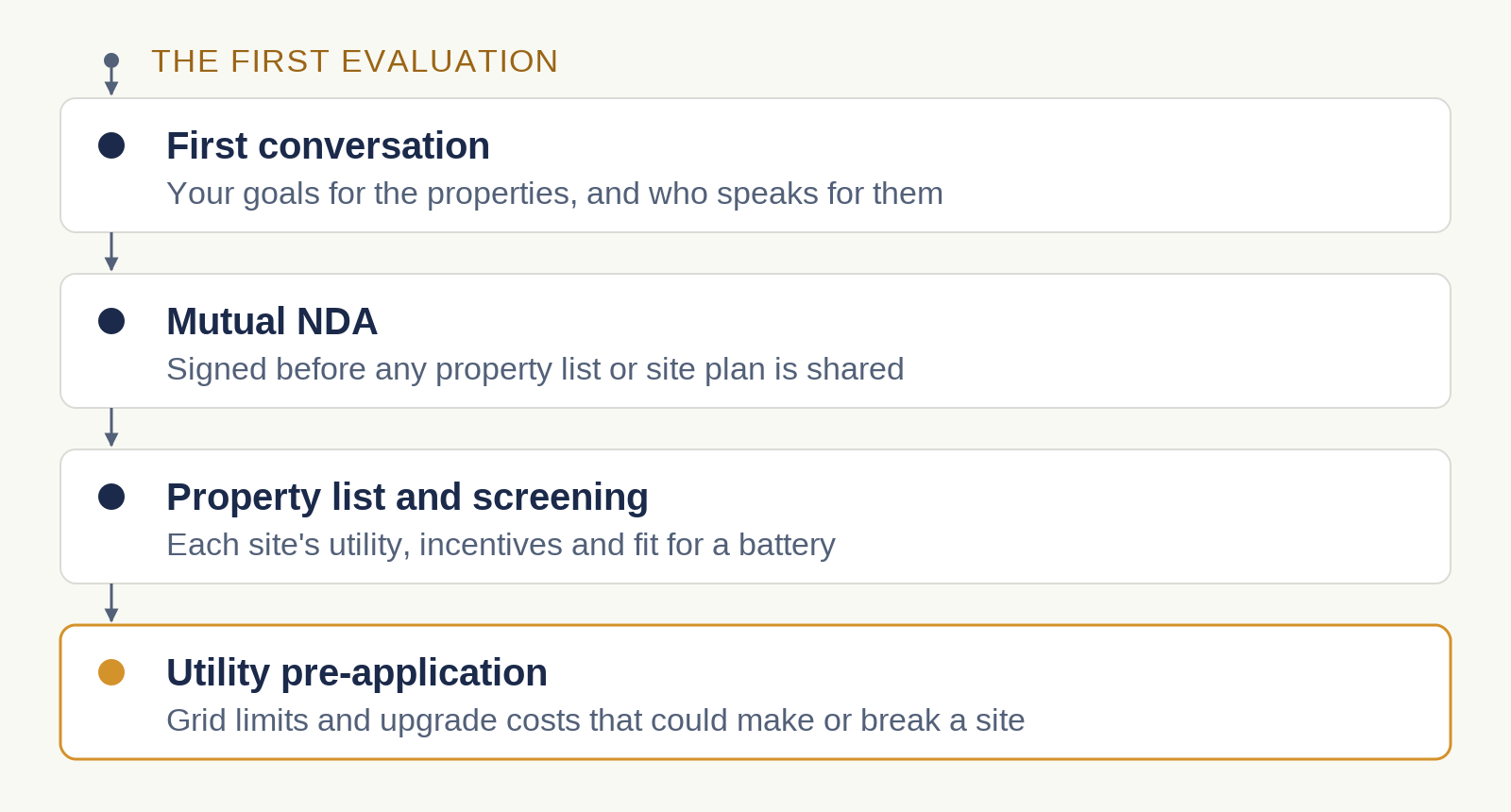
1. A first conversation, then a mutual NDA
When a company holds several large properties, the first step is a conversation about what the business wants from the land. Addresses come later. Treat property lists, tenant details and site plans as confidential during the review, and put a mutual NDA in place before any of them change hands.
- Who acts: your real estate, asset management or energy lead, the developer or engineering firm, and counsel for the NDA.
- What you provide or decide: the purpose of the review and the person authorized to speak for the properties.
- What slows it down or stops it: unclear internal authority, or confidentiality terms the two sides cannot settle.
2. Your property list and a first screening
After the NDA, you share the properties worth a look. A useful screening identifies the utility serving each site and the incentives available there, and compares usable space, likely grid access, daily operations and property rights. Part 2's worksheet approach is a practical way to gather those inputs before the first review.
At this stage a developer can also ask the utility for a pre-application report on a specific site. ComEd charges a nonrefundable $300 for the report and provides the data within 20 business days of a complete request. Source: ComEd DER Interconnection Requirements, Rev. 3, effective September 14, 2026. Under Illinois rules, the report identifies the circuits likely to serve the site and known constraints that might affect a connection. It also says whether upgrades for projects already ahead in the utility's queue there are estimated to exceed set cost thresholds, where those estimates exist. Source: 83 Ill. Adm. Code 466.45. The report is non-binding, but grid upgrade costs can make or break a project, so this early read helps decide which sites deserve more work. Agree early on who pays for screening costs like this, along with legal review.
- Who acts: your team assembles the list. The developer screens it. Property managers flag operating constraints.
- What you provide or decide: addresses, candidate areas, current tenants and planned expansion. Then, which sites deserve further work.
- What slows it down or stops it: existing occupancy, no workable area, or early grid information that points elsewhere. A good screening result means the site is worth more study. It does not give anyone permission to connect.
3. A rights check, then an option or lease
Before anyone signs, confirm who owns each parcel, who has authority to sign for it, and what tenants and lenders already hold. An existing lease or loan document could restrict the same ground the battery would use.
Public examples secure the site with either an option or a lease that starts with a development period. Both are separate events from the start of operating rent. An option can reserve the developer's right to take a lease later. Its terms define exclusivity, access for investigations and the conditions for exercising it. Option periods in public examples run for years: the Delaware River and Bay Authority approved a one-year option with four one-year extensions in 2019, and a New York town board packet from November 2026 proposes an exclusive option of up to four years. For the commitment side of that agreement, see Part 1 on how long a site stays committed before operating rent begins.
The agreement often has to exist before a formal utility application. For community supply and some commercial and industrial applicants, ComEd's current requirements list site control documentation, such as a deed, lease or option agreement, in the application package. A developer that does not own the land shows site control through an agreement with the owner. PJM requires proof of site control at entry to its interconnection process. Source: PJM Inside Lines, September 30, 2026.
- Who acts: you, the developer's project entity and both sides' advisers.
- What you provide or decide: the area, exclusivity, access for investigations, milestones, extensions and how either side exits. Confirm which legal entity is signing.
- What slows it down or stops it: an option that expires, conditions the developer cannot meet, or rights held by a tenant or lender.
What happens between signing and construction?
4. Three tracks at once: grid, land and permits, revenue
After site control, the work splits into three tracks that overlap. Good news on one track says little about the other two.
The grid track. The developer applies to the utility, and the utility studies whether the circuit can handle the battery charging and discharging. ComEd's published chart shows review windows of 60 business days for Level 2 (up to 5 MW), 205 business days for Level 4 (5 to 10 MW) and 275 business days for Part 467 projects above 10 MW. Source: ComEd DER Interconnection Requirements, Appendix 1. The level also depends on line voltage and screening results, so a smaller system can still land in Level 4. Each window has its own triggers and conditions, and none of them measures the time to an operating battery. Projects connecting at transmission level also go through the regional grid operator, PJM in ComEd territory and MISO in Ameren Illinois territory. PJM describes its new review process as designed to take one to two years, depending on impact. The early grid signals to look for are in Part 2's section on what makes a utility connection worth investigating.
The land and permits track. Survey, title and environmental review happen here, along with zoning and fire review. Which zoning rules apply depends on where the property sits. If the property is within a city or village's zoning jurisdiction, check the municipal ordinance. Since June 1, 2026, Illinois law sets standards for storage systems greater than 1,000 kilowatts in county areas outside municipal zoning, where the county has adopted zoning. The law excludes combustion technologies and storage tied to commercial solar or wind farms. Under those standards, the public hearing must end within 60 days of the application, and the county must decide within 30 days after the hearing. The county must also allow at least three years after approval to get a building permit or start construction before the approval can be revoked on that basis. Source: 55 ILCS 5/5-12024, added by Public Act 104-0458. Counties applying these standards may require compliance with NFPA 855, the national standard for installing stationary energy storage. Confirm which fire code, edition and fire authority apply to the site.
The revenue track. The developer needs a way for the battery to earn money, and that choice shapes the project. Illinois ran its first state storage procurement in August 2026. It was limited to transmission-connected projects of at least 20 MW with four hours of discharge, and it excluded projects connected to a distribution system. Source: Illinois Power Agency RFP rules, June 29, 2026. Distribution-connected batteries follow different routes, such as utility programs with their own eligibility and operating terms. If a proposal leans on a state award, Part 1 lists the questions to ask about it.
- Who acts: the developer coordinates surveyors, engineers, the utility and permitting authorities.
- What you provide or decide: existing surveys, title information and site plans. Access for investigation crews on a schedule that protects daily operations. Signatures on permit applications where the property owner must sign.
- What slows it down or stops it: grid study results, title or environmental findings, permit conditions, or no workable revenue route.
5. Financing and the decision to build
Investors and lenders review the whole package before construction money is committed. Their review often reaches back to the land documents. In one public example, Pasadena city staff recommended replacing a previously approved license with a lease because the developer's lender required one. Source: City of Pasadena agenda report, December 8, 2025.
- Who acts: the project company, its investors and lenders.
- What you provide or decide: responses to requested amendments, assignment consents and lender protections in the lease.
- What slows it down or stops it: financing conditions, missing permits or unworkable connection costs. A financing plan is not the same as financial close.
What happens during construction and testing?
6. Utility easement, equipment and construction
The utility often needs its own rights on the property. ComEd will not begin construction until the landowner has signed and recorded a Grant of Easement, and it asks for vesting deeds or title commitments to approve one. Source: ComEd DER Interconnection Requirements, Real Estate section. This is a second agreement, separate from the battery lease.
- Who acts: the construction contractor, the utility's crews and the project company.
- What you provide or decide: the utility easement, staging areas, gate access and a schedule that keeps docks and truck routes working.
- What slows it down or stops it: equipment delivery, unfinished utility work or access conflicts with daily operations.
7. Testing and permission to operate
A battery can be fully built and still not operating. The system needs testing, inspections and the utility's permission to operate. For projects under Illinois' distribution interconnection rules (Part 466), the developer gives the utility at least 15 business days' notice of the planned commissioning test, unless the two agree otherwise. Source: 83 Ill. Adm. Code Part 466.
- Who acts: the contractor and operator run the tests. The utility and local authorities complete their reviews.
- What you provide or decide: access for testing. Confirm which event starts operating rent under your agreement.
- What slows it down or stops it: failed tests, incomplete documents or open utility items.
What does operation and removal involve?
8. Operation, maintenance and eventual removal
Once operating, the battery needs routine maintenance and monitoring, and the owner needs current contacts for the operator and emergency responders. The agreement should assign equipment removal and site restoration to the responsible project entity, along with the funding, the timing and anything allowed to remain. How that removal gets funded belongs in the lease, and Part 1 walks through the lease responsibilities to review.
Where the 2026 county standards apply, a county may require a decommissioning plan with specific protections. The plan can call for removal to a depth of three feet and site restoration within 18 months after the end of the project's life or abandonment. It can also require financial assurance for removal, phased in as 25% of the required amount before full commercial operation starts, 50% before the fifth year of operation starts and 100% before the tenth. The required amount cannot exceed a licensed engineer's estimate of removal cost after salvage value. The county or the participating property owner can be the beneficiary. A project counts as abandoned if it fails for six straight months to pay the property owner what the agreement requires. It also counts as abandoned after 12 months without storing energy, unless force majeure or a defined service interruption caused the outage. These county provisions do not automatically govern sites inside a municipality's zoning jurisdiction. There, confirm the local ordinance, the lease and any other requirements that apply.
- Who acts: the operator maintains the system. The responsible project entity handles removal under the agreement.
- What you provide or decide: continued access and up-to-date contacts. Check the removal security over time.
- What slows it down or stops it: equipment problems, a change of owner, or removal terms the agreement does not address.
Why do battery projects stop before construction?
Issues that can stop a project include:
Where each issue surfaces
| Issue | Where to investigate it |
|---|---|
| The grid cannot take the project at a workable cost | Pre-application data and utility studies (stages 2 and 4) |
| Title, tenant or lender rights conflict with the battery area | The rights check (stage 3) |
| Environmental or permit conditions change the design | Land and permits (stage 4) |
| No revenue route fits the site | The revenue plan (stage 4) |
| Financing terms cannot be met | Financing (stage 5) |
| The option period runs out | Before the option is exercised or the development rights expire, after any extensions |
A rejection at one property does not settle whether another is suitable. Each site keeps its own record through the review.
How long does each stage take?
Published numbers measure different things, so they should never be added into one total. The table labels each by type.
Published numbers by type, never one total
| Stage | Published range | Type of number |
|---|---|---|
| Feasibility after an option is signed | About three months (Mission Clean Energy, solar and storage) | Developer example |
| Option period | Up to four or five years in public examples (above, and Mission Clean Energy) | Contract allowance |
| ComEd review, by level | Level 2: 60. Level 4: 205. Part 467: 275 business days (ComEd) | Utility review window |
| PJM transmission review | One to two years by design (PJM) | Process design |
| Permitting, interconnection and environmental work | Two to four years (Mission Clean Energy, solar and storage) | Developer example |
| Development before construction | About two to three years (Ameren Missouri fact sheet, July 2026) | Utility example, Missouri |
| Construction | About 6 to 12 months (Clean Grid Development). About 12 months (Ameren Missouri) | Developer and utility examples |
| Removal | About 6 to 12 months (Clean Grid Development). Within 18 months of end of life or abandonment where a county requires it | Developer example and county-authorized deadline |
For context, Lawrence Berkeley National Laboratory found that projects built in 2025 had a median of more than five years from interconnection request to commercial operation. That data covers generation projects connecting at transmission level, not distribution-connected batteries. Source: LBNL Queued Up, 2026 edition.
What should you ask before each step?
- 1 Before signing: which entity holds the rights, and who on our side is authorized to grant them?
- 2 Before committing a site: does the equipment area, access route and cable path fit current and planned use?
- 3 Before extending a development period: which milestone is outstanding, who owns it, and what happens if it fails?
- 4 Before construction: what event gives the project possession, and who handles each part of the site work?
- 5 Before calling it operational: what testing, utility permission and commercial operation evidence will we receive?
- 6 During operation: who are the current operator and emergency contacts, and what evidence shows the removal security is in place?
Frequently asked questions
Does the utility need a signed agreement before it looks at my property?
Not for a pre-application report, which a developer can request for a specific site before any agreement exists. A formal application often needs proof of site control. For a developer that does not own the land, that proof comes from an agreement with the owner, such as an option or lease. Requirements vary by utility and application type.
Does the 2026 Illinois county storage law apply to my property?
Only if the property is outside a municipality's zoning jurisdiction, in a county that has adopted zoning, and the storage system is greater than 1,000 kilowatts. If the property sits inside a city or village's zoning jurisdiction, check the municipal ordinance.
Can the developer walk away after signing an option?
An option usually lets the developer decide whether to exercise it. Ask what happens to the site, any payments and the developer's reports if the project stops. Part 1 covers what the developer is committing to at each stage.
Start with a conversation about the properties you have in mind
If your company is weighing battery storage across several Illinois properties, the first step is an introductory conversation about your goals for the land. When it makes sense to look at specific sites, a mutual NDA comes before any property list. The review then follows the stages above, one decision at a time.
General Energy Corporation is an engineering-first company that has worked with large energy users since 1985. It started with mechanical systems such as cooling towers, chilled water systems and boilers, and for the past decade its work has centered on solar and battery storage at customer sites. Learn more about GEC's battery storage engineering.
Request an introductory conversation about your properties.
This article is general information, not legal, tax or engineering advice. Program rules, tariffs and local ordinances change. Confirm current requirements for a specific property with the utility, the local zoning authority and your advisers.
How this guide was made: Drafted by Drew Mays with research help from Claude and Codex, and checked against the primary sources linked above.