The commercial solar Investment Tax Credit is still 30 percent in 2026, 40 percent in a qualifying Energy Community, and the July 4, 2026 begin-construction deadline has already passed. That date decided which placed-in-service runway a project gets, not whether the credit exists. Two paths now govern the credit under Section 48E: a project that established its begin-construction date by July 4, 2026 keeps the four-year continuity window and can be placed in service any time through the end of 2030. A project establishing that date after July 4, 2026 must be placed in service by December 31, 2027. That is roughly an eighteen-month runway, and a typical commercial install fits comfortably inside it if the work starts soon. This guide walks through both paths, what the credit is worth once depreciation is added, the Illinois incentives that apply on top, and the June 6 court ruling on the begin-construction rules.
On June 6, 2026, the U.S. District Court for the District of Columbia vacated Notice 2025-42, the guidance that had limited the 5 percent safe harbor to solar systems at or below 1.5 MW AC. The 5 percent method is now available to projects of every size while the ruling stands, and an appeal is expected. Nothing in this guide's approach changes: GEC engineers systems at or below 1.5 MW AC, where the 5 percent path qualifies under every outcome of the appeal. The full breakdown of the ruling is in what the June 6 ruling means for the 5 percent solar safe harbor.
Fast Facts
- The short version: The July 4, 2026 begin-construction deadline has passed. The credit is still fully available: 30 percent, 40 percent in a qualifying Energy Community. A project that already established its begin-construction date by July 4 has until the end of 2030 to be placed in service. A project starting construction now must be placed in service by December 31, 2027.
- Program: Federal Commercial Solar Investment Tax Credit (Section 48E), with the begin-construction safe harbor.
- Authority: Internal Revenue Code Section 48E and longstanding IRS begin-construction guidance. Notice 2025-42, which added the 1.5 MW AC threshold, was vacated by a federal court on June 6, 2026. An appeal is expected, and GEC's at-or-below-1.5-MW approach qualifies under either outcome.
- What it is worth: 30 percent of total system cost. 40 percent in a qualifying Energy Community. Transferable for cash under Section 6418.
- Who qualifies: Any commercial or industrial taxpayer. Which placed-in-service deadline applies depends on when the project's begin-construction date falls, by July 4, 2026, or after it.
- Begin-construction date: July 4, 2026 is the cutoff that separates the two paths. A project that already established that date by then keeps the longer runway. A project starting today establishes its own begin-construction date now, after the cutoff.
- Place in service by: December 31, 2027 for a project starting construction now. End of 2030 for a project that established its begin-construction date by July 4, 2026, under the continuity safe harbor.
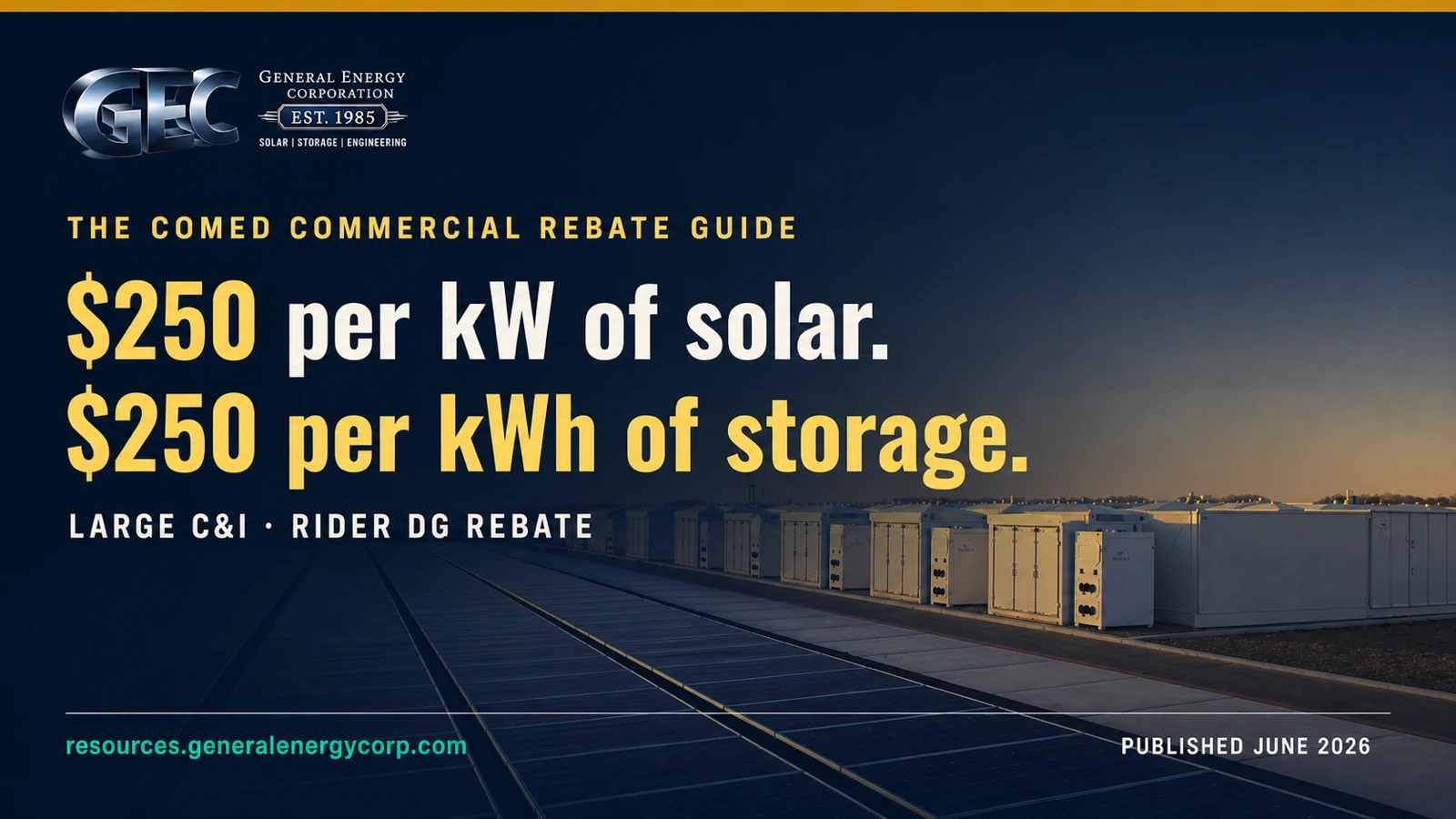
- Combines with: Illinois Shines SRECs, the ComEd or Ameren rebate at $250 per kW of nameplate generating capacity, and MACRS bonus depreciation. Each captured individually.
- Primary sources: IRC Section 48E, including Section 48E(e)(4). IRS Notice 2025-42. Oregon Environmental Council v. IRS, No. 25-4400 (D.D.C. June 6, 2026).
- 1 The 30 percent commercial solar credit is alive. The residential credit (Section 25D) is the one that ended after 2025. Do not let headlines about the residential credit decide a commercial project.
- 2 July 4, 2026 was the deadline to establish a begin-construction date for the longer, 2030 placed-in-service runway. That date has passed. A project starting today establishes its own begin-construction date and must be placed in service by December 31, 2027 to claim the credit, an eighteen-month runway that fits a typical commercial install.
- 3 Establishing a begin-construction date does not commit you to building. For strong projects, GEC puts up its own capital to fund the early commitment, secured by a letter of intent. The LOI does not commit you to build either. You keep the option and the timeline.
- 4 On a taxable commercial project in a qualifying Energy Community, the 40 percent federal credit and 100 percent bonus depreciation recover roughly 57 percent of project cost in year one. Without the Energy Community bonus, the 30 percent credit and depreciation recover about half. Illinois Shines and the ComEd or Ameren rebate apply on top, each on its own timeline. The Illinois detail lives on the Incentives & Safe Harbor pillar.
- 5 A federal court vacated IRS Notice 2025-42 on June 6, 2026, restoring the 5 percent method for systems of every size while the ruling stands. GEC engineers at or below 1.5 MW AC anyway, so the clean path holds under every outcome. The ruling, explained.
The four-click read
Four things to know about the credit today
The whole decision in four cards. Each links to the section that proves it.
What governs the credit now
The July 4, 2026 begin-construction deadline has passed. A project starting construction today must be placed in service by December 31, 2027 to claim the 30 percent credit, 40 percent in a qualifying Energy Community. For strong projects, GEC funds the begin-construction commitment itself through a letter of intent.
How it worksWhat the December 2027 deadline means
A project establishing its begin-construction date after July 4, 2026 must be placed in service by December 31, 2027, a fixed runway rather than the longer window through 2030 available to projects that started earlier. The credit value is the same either way.
The placed-in-service ruleThe 1.5 MW AC line
A June 6 court ruling vacated the notice that limited the 5 percent method to systems at or below 1.5 MW AC. GEC engineers the AC nameplate to sit at or below that line anyway, so the 5 percent path holds under every outcome of the appeal.
The thresholdWhat the credit is worth
In a qualifying Energy Community, the 40 percent federal credit plus 100 percent bonus depreciation recovers about 57 percent of project cost in year one, before any Illinois incentive. At the base 30 percent credit, the figure is about half.
What it's worthWhy the July 4 date still matters
July 4, 2026 was the federal begin-construction deadline for the longer, four-year placed-in-service runway under Section 48E. That date has passed, and it did not close the credit. Two paths now apply. A project that established its begin-construction date by July 4, 2026 has until the end of 2030 to be placed in service. A project establishing that date after July 4, 2026 must be placed in service by December 31, 2027 to claim the credit. For most commercial facilities, that is roughly an eighteen-month runway from a decision today, which comfortably fits a typical commercial install timeline when the engineering assessment starts soon.
Does the commercial solar tax credit still exist in 2026?
Yes. The commercial and industrial solar credit under Section 48E is still 30 percent in 2026, 40 percent in a qualifying Energy Community. The July 4, 2026 begin-construction deadline decided which placed-in-service runway a project gets, not whether the credit exists. A project establishing its begin-construction date after that day remains fully eligible. It must simply be placed in service by December 31, 2027. The credit that ended is the residential one, Section 25D, which applied to homeowners and was terminated for systems placed in service after 2025. These are two different credits in two different parts of the tax code, and the headlines about the residential credit ending do not apply to a business installing solar on its own facility.
This is the single most common point of confusion in 2026, and it costs commercial owners real money when they assume the window has closed because July 4 has passed. For a manufacturer, distributor, or commercial property owner, the federal credit is intact at 30 percent, the 10 percent Energy Community bonus is available where the facility address qualifies, and a project starting today only needs to be placed in service by December 31, 2027 to capture it.
What did the July 4, 2026 deadline actually require?
July 4, 2026 was a begin-construction deadline. It was never the date a system had to be installed, energized, or paid off. A commercial project that established its begin-construction date by that day preserved the 30 percent credit vintage in effect at the time and has until the end of 2030 to be placed in service under the IRS continuity safe harbor. A project establishing its begin-construction date after July 4, 2026 still gets the same credit. It runs on the December 31, 2027 placed-in-service deadline instead of the 2030 runway.
That distinction is what makes today's decision workable. Whichever path a project is on, the work that has to happen by the relevant date is the whole installation, not a paperwork step: engineering, financing, leased-facility consent where applicable, interconnection studies with ComEd or Ameren, equipment procurement, and construction through to energization. For a project starting now, that is a comfortable runway if the first conversation happens soon.
How does a commercial project establish a begin-construction date?
The IRS recognizes two ways to establish a begin-construction date for solar ITC purposes. Establishing that date by July 4, 2026 is what secured the longer, 2030 placed-in-service runway for projects already underway. A project establishing its begin-construction date after July 4, 2026 does not need to satisfy either test to keep the credit. It is simply governed by the December 31, 2027 placed-in-service deadline. GEC documents the begin-construction date properly on every project regardless, since it is the record a tax advisor and the IRS expect, and it handles component sourcing and the prevailing-wage and apprenticeship compliance the bonus credits require, so eligibility is captured cleanly rather than lost on a technicality.
The 5 percent cost method
A taxpayer establishes a begin-construction date by paying or incurring at least 5 percent of total project cost under a binding written contract. For a 500 kW commercial system priced around $1,000,000, that is roughly $50,000. Vague intent does not qualify. An invoiced deposit or purchase order on modules, inverters, or racking that crosses the threshold does. This is the test that determined which projects secured the longer 2030 placed-in-service runway by establishing their begin-construction date on or before July 4, 2026. IRS Notice 2025-42 had limited the 5 percent method to systems at or below the 1.5 MW AC low-output threshold. A federal court vacated that notice on June 6, 2026, making the method available to projects of every size while the ruling stands. GEC engineers the system AC nameplate to sit at or below 1.5 MW AC regardless, because that covers most commercial rooftop and ground-mount projects and keeps the 5 percent path valid under every outcome of the expected appeal.
The physical work test
Alternatively, a taxpayer can establish a begin-construction date by beginning physical work of a significant nature: custom fabrication of project equipment under a binding written contract, structural racking installation, or the start of switchgear and transformer work. The threshold is qualitative rather than a dollar figure, and the IRS expects documented continuous progress from that point. Under Notice 2025-42 this was the only path for systems above 1.5 MW AC, and it remains the conservative choice for larger systems while the June 6 vacatur is on appeal.
The two begin-construction methods compared
| Method | What it requires | Best fit | Documentation |
|---|---|---|---|
| 5% cost method | Pay or incur 5% of total project cost under a binding contract | Systems at or below 1.5 MW AC (most commercial projects) | Invoices, purchase orders, binding contract |
| Physical work test | Begin physical work of a significant nature, then continuous progress | Systems above 1.5 MW AC | Fabrication contracts, engineering records, build logs |
IRS Notice 2025-42 set a 1.5 MW AC low-output threshold for the 5 percent method. A federal court vacated the notice on June 6, 2026, and an appeal is expected. GEC engineers every commercial system to sit at or below that line on purpose, so its projects stay on the clean 5 percent path whether the notice stays vacated or comes back. The begin-construction position never depends on how the litigation resolves.
Establishing a begin-construction date is not the same as signing a construction contract and breaking ground on the full system. It does not commit the owner to building. It commits a defined cost or a defined scope of physical work, and it clarifies which placed-in-service deadline the project is on.
What is the 30 percent worth once you add depreciation?
For a taxable business, the headline 30 percent is only part of the recovery. The system basis is also eligible for 100 percent first-year bonus depreciation under current law, which recovers an additional portion of project cost for owners with the tax position to use it. Combined, the federal credit and first-year depreciation recover about half of project cost on a typical commercial project, before any state or utility incentive. In a qualifying Energy Community, where the federal credit rises to 40 percent, that first-year recovery reaches roughly 57 percent. The detailed payback math, including demand-charge savings, is modeled per project. The table below shows the federal credit at representative Illinois manufacturer scale.
Representative federal economics for Illinois commercial solar (2026 pricing)
| System Size | Typical Project Cost | 30% Federal ITC | 5% Begin-Construction Figure |
|---|---|---|---|
| 200 kW rooftop | ~$400,000 | ~$120,000 | ~$20,000 |
| 500 kW rooftop | ~$1,000,000 | ~$300,000 | ~$50,000 |
| 1 MW rooftop or ground | ~$2,000,000 | ~$600,000 | ~$100,000 |
| 1.5 MW rooftop or ground | ~$3,000,000 | ~$900,000 | ~$150,000 |
Representative figures only. Actual project cost depends on roof type, electrical infrastructure, and whether storage is integrated, and the bonus depreciation benefit depends on the owner being a taxable business with the appetite to use it. The 5 percent begin-construction figure in the table is the historical test that determined the 2030 runway. A project starting today is on the December 31, 2027 placed-in-service deadline instead, and the credit percentage and dollar value are unaffected. The credit is also transferable to third-party buyers under Section 6418 if the owner cannot use it directly.
Which Illinois incentives apply on top of the federal credit?
Illinois is where the federal credit goes from strong to decisive, because several state and utility programs apply on top of it. For an Illinois commercial or industrial facility, the package usually includes:
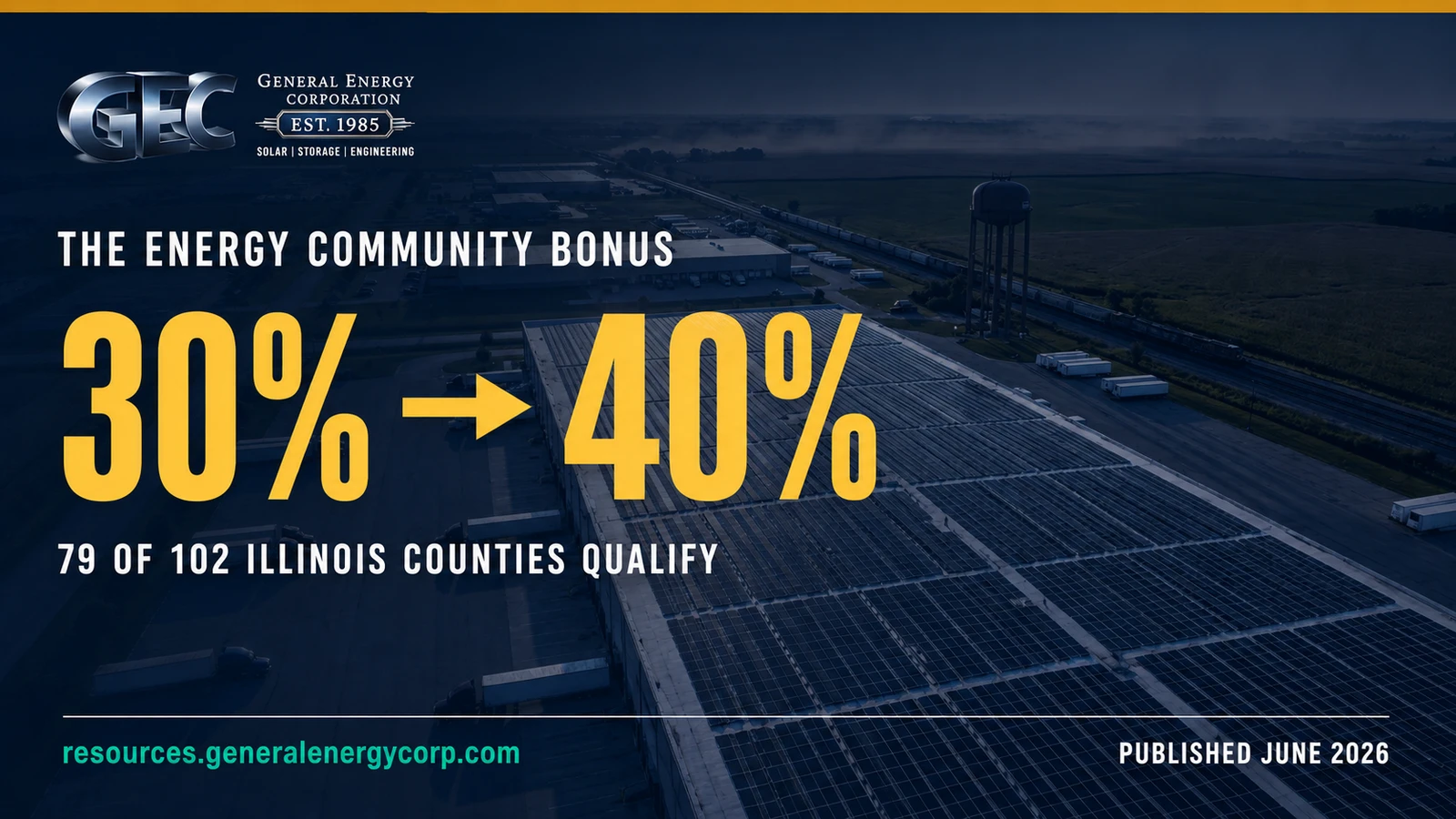
- The 10 percent Energy Community bonus. Added to the 30 percent federal credit where the facility address sits in an IRS-designated Energy Community census tract. Many Illinois industrial corridors qualify, verified at the address.
- Illinois Shines SRECs. Fifteen years of Solar Renewable Energy Credit revenue through Illinois Shines, paid out over the first several years of the contract rather than as a single lump sum. Registration timing matters because the program fills in blocks.
- The ComEd or Ameren distributed generation rebate. Most of Illinois is served by ComEd in the north or Ameren downstate, and both pay the same distributed generation (smart inverter) rebate of $250 per kW of nameplate generating capacity, roughly 10 percent of total project cost, as a direct cash check after commissioning. A 1 MW system earns a $250,000 check. See the ComEd rebate and the Ameren Illinois rebate.
- MACRS and bonus depreciation. Accelerated cost recovery for taxable businesses, applied to the system basis on top of the credit and the rebate.
None of these apply automatically. Each is verified at the project and address level, and the real economics depend on the verified package, not the theoretical maximum. The full program detail, including who qualifies and what each one pays, is worked out on the Incentives & Safe Harbor pillar.
GEC does not outsource engineering. The incentive figures in your proposal come from the same licensed engineers who design and build the system, so the numbers you see are the numbers GEC backs. Final incentive capture depends on your tax position and program availability at the time of filing.
Find Out What Your Facility Qualifies For
Send one recent utility bill per meter and your facility address. GEC verifies Energy Community status, identifies the federal and Illinois programs that apply, and returns an indicative system design with a per-incentive projection, usually within a week. No commitment to move forward, and for strong projects GEC funds the early commitment itself, secured by a letter of intent.
Is it too late to capture the credit?
No. The July 4, 2026 begin-construction deadline decided which placed-in-service runway a project gets. It did not close the credit. A project starting today establishes its own begin-construction date after July 4, 2026 and must be placed in service by December 31, 2027, roughly eighteen months from now. For a typical commercial rooftop or ground-mount system, that is a workable runway if the first conversation happens soon: a site visit and utility-bill review, an engineering assessment, a decision meeting with the owner and finance, then design, permitting, procurement, and construction through to energization. The detailed week-by-week version, written for a 100 to 500 employee manufacturer, is in the Illinois manufacturer decision guide.
The reason to start soon is not a begin-construction test anymore, it is the calendar for actually finishing the project. Design, interconnection with ComEd or Ameren, equipment procurement, and construction all have to happen inside the same runway that ends December 31, 2027. Starting the engineering assessment now gives the project the most room to work with.
What happens if a project starts construction now?
July 4, 2026 has passed, and the federal credit did not vanish with it. A project establishing its begin-construction date after that day is on the second path: it must be placed in service by December 31, 2027 to claim the credit, rather than the longer runway through 2030 available to projects that established their begin-construction date earlier. Here is the real difference between the two paths:
- A firm placed-in-service date. A project establishing its begin-construction date after July 4, 2026 must be placed in service by December 31, 2027 to claim the credit, rather than the flexible, multi-year window available to projects that began construction earlier.
- Battery storage paired with solar follows its own Section 48E schedule and is not tied to the solar system's placed-in-service date, so a combined solar-and-storage project's timing is modeled separately.
- Exposure to the Illinois Shines program moving to a lower-paying block, since registration timing is not guaranteed at current rates indefinitely.
- Continued exposure to rising ComEd and Ameren demand and capacity charges, with no on-site mitigation in place yet.
None of this changes the core economics: the 30 percent credit, 40 percent in a qualifying Energy Community, is the same credit on either path. The difference is entirely about the calendar a project has to reach completion, not the value of the incentive itself. The capacity-charge pressure driving Illinois bills higher is its own subject, covered in the Illinois Energy Market hub.
How to plan a project for the December 31, 2027 deadline
The realistic sequence for a commercial facility starting today, working toward a December 31, 2027 placed-in-service date:
- 1 Share 12 months of utility bills and the facility address. Two inputs are enough to verify Energy Community status, identify the applicable programs, and size a preliminary system.
- 2 Get the engineering assessment. Structural review, interconnection feasibility, indicative system design, project cost estimate, and modeled incentive capture across the federal credit, the Energy Community bonus, Illinois Shines, the utility rebate, and depreciation.
- 3 Hold the decision meeting. Owner, operations, and finance review the assessment together and choose a financing structure: cash, capital lease, operating lease, PPA, or credit transfer under Section 6418.
- 4 Document the begin-construction date. GEC documents the project's begin-construction date properly regardless of method, since it is the record your tax advisor and the IRS expect and it confirms the December 31, 2027 placed-in-service deadline applies.
- 5 Move through design, permitting, and construction to energization. From the decision meeting, GEC sequences interconnection, procurement, and construction to fit inside the runway, and gives you a project-specific schedule at the engineering assessment.
How GEC captures the credit for your facility
GEC captures the federal credit as a service, whichever path a project is on. You send one recent utility bill per meter and your facility address. GEC verifies Energy Community status, models the full incentive set against your roof and load inside a week, and documents the begin-construction date on the placed-in-service timeline that applies. For strong projects, GEC funds the early commitment through a letter of intent.
- 1 Send two inputs. One recent utility bill per meter and the facility address. That is enough to verify Energy Community status, identify every program that applies, and size a preliminary system.
- 2 Get the model in a week. GEC's licensed engineers model the federal credit, the Energy Community bonus, Illinois Shines, the ComEd or Ameren rebate, and depreciation against your specific roof, load profile, and utility territory. Engineering, procurement, and construction sit under one roof, so the numbers come from the team that builds the system.
- 3 Hold the decision meeting. Owner, operations, and finance review the model and choose a structure: cash, lease, PPA, or credit transfer under Section 6418.
- 4 Document the credit on the clean path. GEC sizes the system at or below 1.5 MW AC and documents the begin-construction date on the 5 percent cost method, the simpler path, done properly.
- 5 The LOI does the work. For strong projects, GEC puts up its own capital to fund the early commitment, secured by a letter of intent. That preserves the credit and keeps your options open without committing you to build. If the project ultimately does not pencil, your exposure stays minimal. You keep the option and the timeline.
The site assessment is free, and there is no commitment to move forward.
A real Illinois result: Core Pipe Products
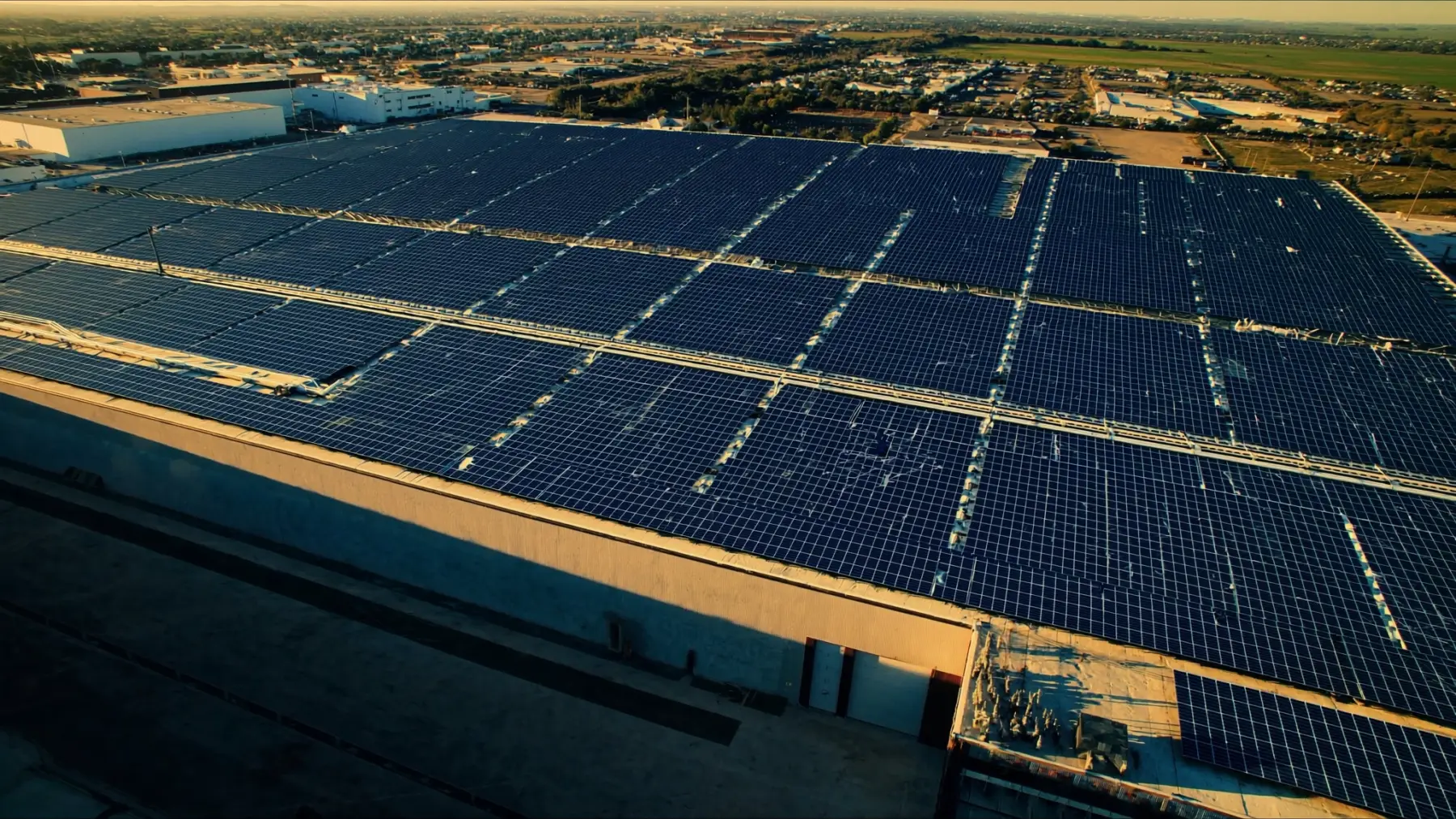
Core Pipe Products is an Illinois manufacturer in Carol Stream that worked with General Energy Corporation on an 802 kW rooftop solar installation. The system offsets roughly 90 percent of the facility's electricity use and generates more than $76,000 in annual savings. Carol Stream sits in a confirmed Energy Community zone, so the project captured the 10 percent bonus on top of the 30 percent base credit. Before committing, the company's CEO had his CPA independently verify every number GEC presented. The numbers held. Project economics vary site to site, but they are specific, verifiable, and not theoretical.
Frequently Asked Questions
No. The commercial and industrial solar credit under Section 48E is still 30 percent in 2026, 40 percent in a qualifying Energy Community, regardless of whether a project established its begin-construction date before or after July 4, 2026. The credit that ended is the residential one, Section 25D, for systems placed in service after 2025. They are separate credits, and the residential change does not affect a business installing solar on its own facility.
July 4, 2026 was the date by which a project needed to establish a begin-construction date, through either the 5 percent cost method or the physical work test, to qualify for the longer placed-in-service runway through the end of 2030. That date has passed. A project establishing its begin-construction date after July 4, 2026 still gets the same 30 percent, or 40 percent, credit. It simply must be placed in service by December 31, 2027 instead.
If your project's begin-construction date falls after July 4, 2026, yes, the system has to be placed in service, meaning fully installed and operating, by December 31, 2027 to claim the credit. For a typical commercial system, that is roughly an eighteen-month runway from a decision today, comfortable if design and procurement start soon.
No. Establishing a begin-construction date commits a defined cost (under the 5 percent method) or a defined scope of physical work (under the physical work test). It does not obligate the owner to complete the system. Many owners establish their begin-construction date and then finalize financing, leased-facility consent, and the build timeline across the window that follows.
The 5 percent method means paying or incurring at least 5 percent of total project cost under a binding written contract. For a 500 kW system priced around $1,000,000, that is roughly $50,000. An invoiced deposit or purchase order on modules, inverters, or racking that crosses the threshold qualifies. Vague intent does not.
The 5 percent method means paying or incurring 5 percent of project cost under a binding contract. The physical work test means starting physical work of a significant nature, with documented continuous progress. IRS Notice 2025-42 had limited the 5 percent method to systems at or below 1.5 MW AC. A federal court vacated that notice on June 6, 2026, making the 5 percent method available to every size while the ruling stands. GEC engineers systems at or below 1.5 MW AC either way, so the simpler method always applies.
On June 6, 2026, the U.S. District Court for the District of Columbia vacated IRS Notice 2025-42, the guidance that had limited the 5 percent method to solar systems at or below 1.5 MW AC. The 5 percent method is restored for projects of every size while the ruling stands, and an appeal is expected. The July 4, 2026 deadline itself is set by statute and did not move. Systems engineered at or below 1.5 MW AC, which is how GEC sizes commercial projects, qualify for the 5 percent method under every outcome.
For a taxable business, the 30 percent credit plus 100 percent first-year bonus depreciation recovers about half of project cost in year one. In a qualifying Energy Community, where the federal credit rises to 40 percent, that first-year recovery reaches roughly 57 percent. Illinois Shines and the ComEd rebate apply on top, each on its own timeline.
An Illinois commercial project can add the 10 percent federal Energy Community bonus where the address qualifies, 15 years of Illinois Shines SREC revenue, and the ComEd or Ameren distributed generation rebate of $250 per kW of nameplate generating capacity, roughly 10 percent of project cost. MACRS and bonus depreciation apply to the system basis. Each is verified at the project and address level, not assumed.
It is on the second path: it must be placed in service by December 31, 2027 to claim the credit, an eighteen-month-class runway rather than the longer window through 2030 available to projects that established an earlier begin-construction date. The credit value itself, 30 percent, 40 percent in a qualifying Energy Community, is identical on either path.
No. Battery storage paired with solar qualifies under its own Section 48E schedule and is not subject to the solar system's placed-in-service deadline. GEC models the storage timeline separately from the solar system when structuring a combined project. Confirm the specifics for your project with your tax advisor.
See What the Two-Path Rule Means for Your Facility
The July 4, 2026 begin-construction deadline has passed, and the 30 percent credit, 40 percent in a qualifying Energy Community, is still fully available. A project starting today has until December 31, 2027 to be placed in service, an eighteen-month runway that fits a typical commercial install. For strong projects, GEC funds the early commitment through a letter of intent with no commitment to build. Start today by sharing 12 months of utility bills and your facility address. Personal reply within one business day.
This guide is general information, not tax or legal advice. Federal and Illinois incentive values depend on project specifics, the owner's tax position, program availability at the time of application, and current law, all of which can change. Confirm eligibility and figures with your tax advisor and against the primary sources linked here before acting.
Continue the series
- The June 6 ruling: Court vacates IRS Notice 2025-42, what the ruling restores, the appeal risk, and why the at-or-below-1.5-MW path holds either way.
- Up to the hub: Incentives & Safe Harbor, the pillar that ties every Illinois program together.
- The Illinois-manufacturer decision guide: Safe harbor for Illinois manufacturers in 2026, the week-by-week version for 100 to 500 employee plants.
- Why costs are climbing: Illinois Energy Market, the PJM capacity and rate context behind the urgency.
- The value half of the story: The Energy Community bonus in 2026, how the 10 point bonus takes the credit to 40 percent across most of Illinois.
- Sibling monographs (planned): Illinois Shines SRECs, and the ComEd and Ameren DG rebate.
References
- 1 IRC Section 48E (commercial clean electricity investment credit), including Section 48E(e)(4) (placed-in-service deadline for projects that establish their begin-construction date after the applicable cutoff). law.cornell.edu/uscode/text/26/48E
- 2 IRC Section 6418 (transferability of credits). law.cornell.edu/uscode/text/26/6418
- 3 IRS Notice 2025-42 (beginning of construction, 1.5 MW AC threshold, vacated June 6, 2026, appeal expected). irs.gov/pub/irs-drop/n-25-42.pdf
- 4 Oregon Environmental Council v. Internal Revenue Service, No. 25-4400, U.S. District Court for the District of Columbia, memorandum opinion of June 6, 2026 (vacating Notice 2025-42). Covered in the ruling breakdown.
- 5 IRS, One Big Beautiful Bill provisions. irs.gov/newsroom/one-big-beautiful-bill-provisions
- 6 DOE, Guide to the Federal Investment Tax Credit for Commercial Solar PV. energy.gov (PDF)
- 7 SEIA, Depreciation of Solar Energy Property (MACRS). seia.org/depreciation-solar-energy-property-macrs
- 8 Illinois Shines. illinoisshines.com
- 9 ComEd Distributed Generation rebate. comed.com/smart-energy/.../solar-rebates
- 10 Ameren Illinois renewables and solar. ameren.com/service/renewables/solar
- 11 DSIRE, ComEd Distributed Generation and Storage Rebates. programs.dsireusa.org (DSIRE)