Commercial Solar ITC and Illinois Incentives FAQ: 2026 Answers for C&I Buyers
Direct answers to the questions Illinois commercial and industrial buyers are asking in 2026: the federal solar ITC, the two-path rule now that the July 4 begin-construction deadline has passed, what the credit is worth, and the Illinois incentives that apply on top.
This page answers the questions Illinois commercial and industrial buyers ask most often about solar in 2026: whether the federal credit still exists, what the July 4, 2026 begin-construction deadline required and what governs a project starting today now that it has passed, what the credit is worth, and which Illinois programs apply on top. Each answer is short and direct. For the full walkthrough, start with the 2026 safe-harbor guide, and for program detail see the Incentives & Safe Harbor pillar.
The federal credit and the 2026 deadline
No. The commercial credit under Section 48E is still 30 percent in 2026, 40 percent in a qualifying Energy Community, regardless of whether a project establishes its begin-construction date before or after July 4, 2026. The credit that ended was the residential one, Section 25D, for systems placed in service after 2025. They are separate credits, and the residential change does not affect a business installing solar on its own facility.
Section 25D was the residential credit for homeowners, and it ended for systems placed in service after 2025. Section 48E is the commercial and industrial credit for businesses, and it remains at 30 percent whether a project establishes its begin-construction date before or after July 4, 2026. A commercial owner uses 48E, not 25D.
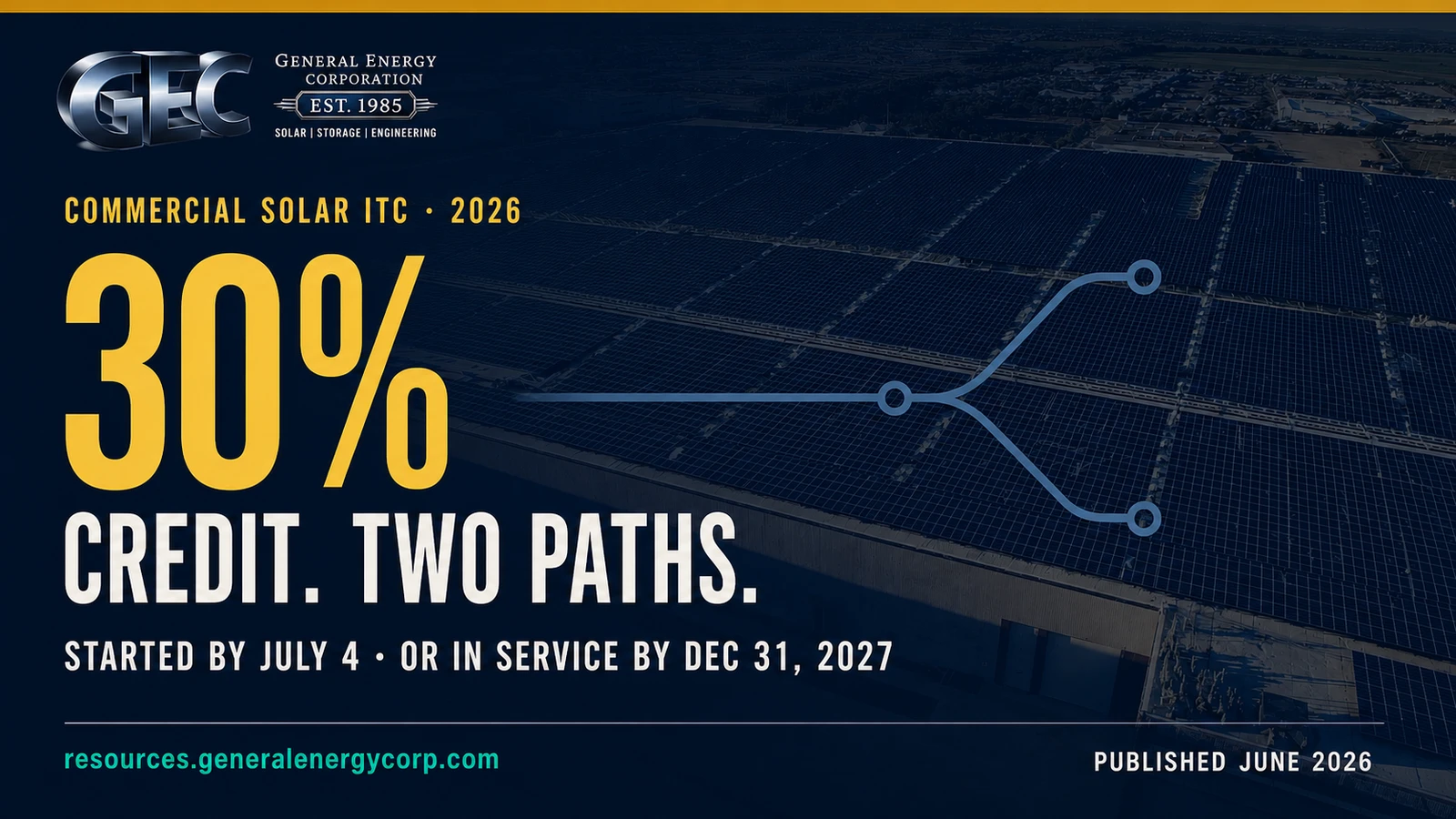
It was the federal begin-construction deadline that determined which placed-in-service runway a project gets under Section 48E. That date has passed. A project that established its begin-construction date by then preserves the 30 percent credit vintage and has until the end of 2030 to be placed in service. A project establishing that date after July 4, 2026 gets the same credit. It must be placed in service by December 31, 2027 instead.
The credit does not disappear. A project establishing its begin-construction date after July 4, 2026 must be placed in service by December 31, 2027 to claim the credit, roughly eighteen months, rather than the longer window through 2030 available to projects that started earlier. The credit percentage itself, 30 percent, 40 percent in a qualifying Energy Community, is the same either way.
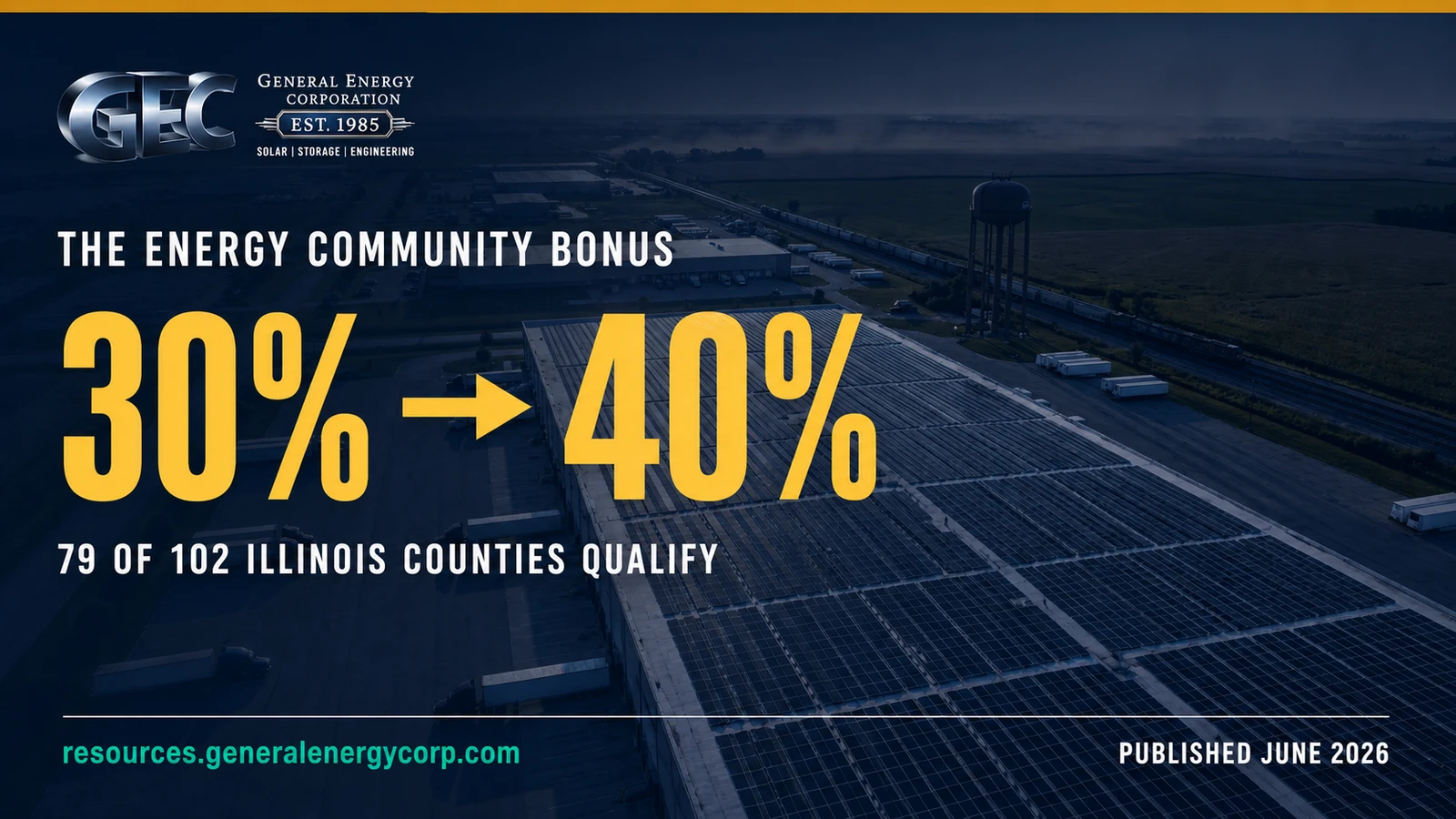
The base credit is 30 percent. A 10 percent Energy Community bonus is added where the facility address sits in an IRS-designated Energy Community census tract, for up to 40 percent federal. Many Illinois industrial corridors qualify, and eligibility is verified at the address using the federal designated-area tool.
Beginning construction and safe harbor
Two IRS methods qualify. The 5 percent cost method means paying or incurring at least 5 percent of total project cost under a binding contract. The physical work test means beginning physical work of a significant nature, then maintaining continuous progress. IRS Notice 2025-42 had limited the 5 percent method to systems at or below 1.5 MW AC. A federal court vacated that notice on June 6, 2026, restoring the method for every size while the ruling stands, and an appeal is expected. GEC engineers systems at or below 1.5 MW AC either way, so the simpler 5 percent path always applies.
Roughly 5 percent of total project cost. For a 500 kW system near $1,000,000 that is about $50,000. For a 1.5 MW system near $3,000,000 it is about $150,000. Exact pricing depends on roof type, electrical infrastructure, and whether battery storage is included.
No. It commits a defined cost or a defined scope of physical work and preserves the credit vintage. It does not obligate the owner to complete the system. Many owners establish their begin-construction date, then finalize financing, leased-facility consent, and the build timeline across the window that follows.
Yes, with the right lease structure. The common path is a lease amendment granting rooftop rights and clarifying energy and incentive ownership. PPA structures and credit transfer under Section 6418 work well for leased facilities because they do not require the tenant to claim the credit directly. The lease work can happen during the build window.
What the credit is worth: ROI, depreciation, financing
For a taxable business, the 30 percent credit combines with MACRS and 100 percent first-year bonus depreciation to recover more than half of project cost before any state or utility incentive. The exact benefit depends on the owner's tax position, and the credit is transferable under Section 6418 if the owner cannot use it directly.
Yes. Section 6418 allows the commercial ITC to be transferred to third-party tax buyers for cash. This is common for owners with limited tax appetite, and for tax-exempt institutions that pair transfer or direct-pay structures with the project. The structure is decided during the financing review.
The common structures are cash purchase, equipment loan, capital or operating lease, a power purchase agreement (PPA), and C-PACE. Each treats the credit, depreciation, and balance-sheet impact differently. The right structure depends on the owner's tax position and cash-flow goals, and is chosen during the decision meeting rather than assumed up front.
Yes. Standalone and solar-paired battery storage qualifies for the ITC, and storage runs on a longer federal timeline than the solar begin-construction deadline. Storage is what reduces the demand and capacity charges that make up a large share of an Illinois commercial bill, so it often carries the strongest part of the project economics.
Illinois incentives and program detail
An Illinois commercial project can combine the 30 percent federal credit, the 10 percent Energy Community bonus where the address qualifies, Illinois Shines SREC revenue over 15 years, the ComEd Distributed Generation rebate at $250 per kW of nameplate generating capacity, and MACRS depreciation. None apply automatically. Each is verified at the project and address level.
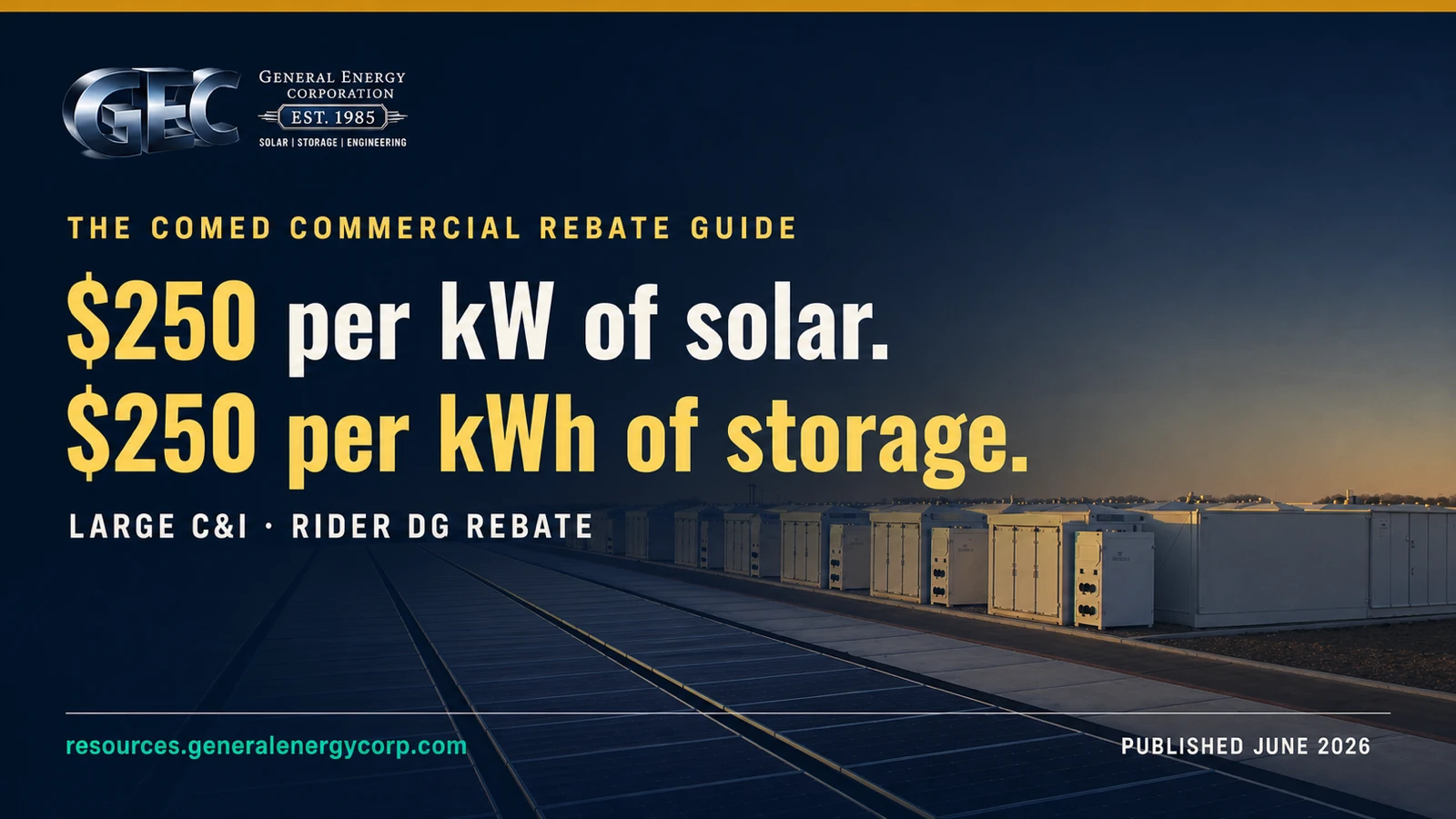
ComEd's Distributed Generation Rebate, also called the Smart Inverter Rebate, pays $250 per kW of nameplate generating capacity to commercial and industrial customers. It is a direct cash payment issued after commissioning. A 500 kW system earns a $125,000 check, and a 1 MW system earns $250,000. It is first-come, first-served from a limited annual pool.
Illinois Shines is the state program that pays for the Solar Renewable Energy Credits a system generates, over a 15-year term. The current commercial vintage pays materially more per SREC than 2024 levels. The Adjustable Block Program fills in blocks rather than on a fixed calendar, so registration timing affects the rate a project locks in.
Possibly. The 10 percent Energy Community bonus applies to projects in IRS-designated census tracts, based on brownfield status or fossil-fuel employment history. Many Illinois locations qualify, especially downstate, legacy coal regions, and select industrial tracts up north. Carol Stream, where GEC built the Core Pipe Products system, is a confirmed Energy Community. Eligibility is verified at the address.
Costs, the grid, and timing
Mainly capacity costs, not fuel. The PJM capacity auction for the ComEd zone cleared sharply higher, driven in part by data-center demand, and those costs flow into commercial bills. Demand and capacity charges are the fastest-rising part of the bill, and on-site solar paired with storage is what targets them directly.
No. A project starting today establishes its own begin-construction date after July 4, 2026 and must be placed in service by December 31, 2027 to claim the credit, roughly eighteen months. For most Illinois facilities, that is a workable runway if the work starts soon: a site visit and bill review, an engineering assessment, a decision meeting, then design, procurement, and construction through to energization.
Twelve months of utility bills, one per meter, and the facility address. From those two inputs GEC verifies Energy Community status, identifies the programs that apply, and returns an indicative system design with project cost and a per-incentive projection, usually within a week. There is no commitment to move forward.
Get Your Facility's Numbers
Send 12 months of utility bills, one per meter, and your facility address. GEC verifies which federal and Illinois programs apply and returns an indicative design with a per-incentive projection, usually within a week. No commitment to move forward.
C&I solar and energy strategy advisor. $5M+ in USDA REAP grants secured, 12 states served, SEIA policy contributor. Founder of Envision Energy Solutions and Vice President of C&I Energy Solutions at General Energy Corporation, a 40-year engineering-first EPC with more than 900 completed projects.
We use essential cookies to operate this site and, with your consent, analytics cookies to understand how it is used. Read our Cookie Policy or Privacy Policy for details. You can change your choice anytime via "Cookie Preferences" in the footer.