ComEd pays commercial and industrial customers a direct cash rebate for distributed solar and paired battery storage, separate from the federal tax credit. A 500 kW solar system with 500 kWh of storage collects $250,000 from ComEd alone, before the federal credit, depreciation, or Illinois Shines touch the project.
Fast Facts
- The short version: ComEd's Rider DG Rebate pays a commercial or industrial customer $250 per kW of solar and $250 per kWh of paired storage as a direct check, separate from and on top of the federal tax credit. A 500 kW plus 500 kWh project collects $250,000 from ComEd alone.
- Program: Commonwealth Edison Rider DG Rebate, the distributed generation and storage rebate, sometimes called the smart inverter rebate.
- Authority: Section 16-107.6 of the Illinois Public Utilities Act. Effective December 15, 2022, for facilities interconnected to ComEd's distribution system after August 11, 2022.
- What it pays large C&I: $250 per kW of nameplate generating capacity for solar, and $250 per kWh of nameplate capacity for storage. Residential and small commercial under the 100 kW demand class receive $300 per kW and $300 per kWh.
- Who qualifies: ComEd-territory customers whose system interconnects through a smart inverter on the Illinois approved inverter list. Storage must be paired with a qualifying solar facility under the current tariff.
- Size cap: The distributed generation facility must have a total rated capacity at or below 5,000 kW (5 MW). GEC engineers commercial systems at or below 1.5 MW AC, always under that ceiling.
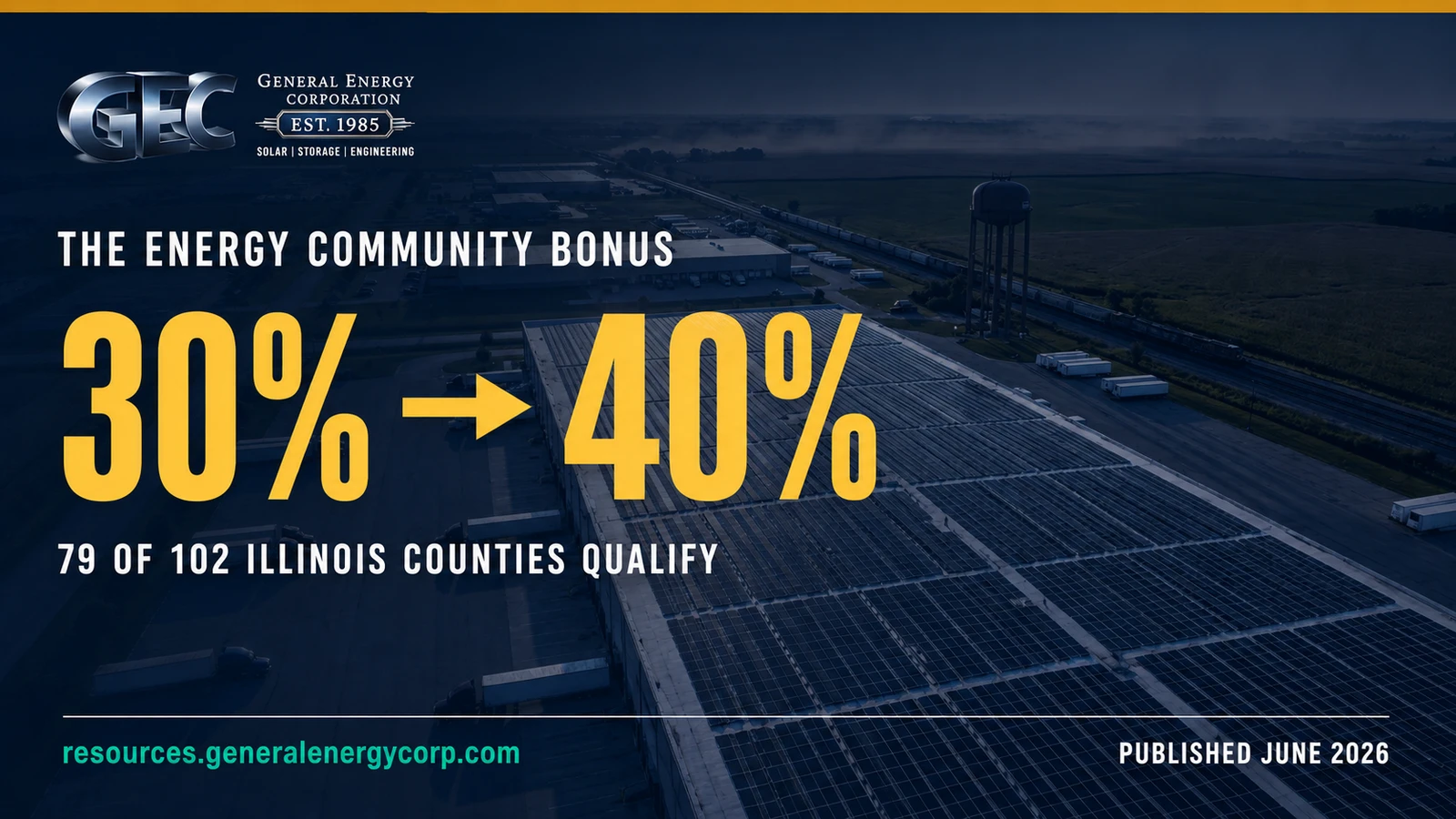
- Combines with: The 30 percent federal credit plus the 10 point Energy Community bonus (40 percent across most of Illinois), Illinois Shines SREC revenue, and MACRS depreciation. Each one is claimed on its own; nothing gets rolled into a single blended percentage.
- Primary sources: ComEd Rider DG Rebate Terms and Conditions. ComEd solar rebates page. DSIRE program 22233. Section 16-107.6, Illinois Public Utilities Act.
- 1 ComEd's Rider DG Rebate is a direct cash payment, not a tax credit. For large commercial and industrial customers it pays $250 per kW of solar and $250 per kWh of paired battery storage.
- 2 The widely quoted $300 figure is the residential and small-commercial rate, for facilities under the 100 kW demand class. Almost every commercial and industrial facility clears 100 kW and collects $250. Leading with $300 to a business is a residential page talking to the wrong reader.
- 3 The solar rebate and the storage rebate are separate and additive. A 500 kW solar plus 500 kWh storage project collects $125,000 plus $125,000, or $250,000 from ComEd, before any federal or state incentive.
- 4 Under the current tariff the battery must be paired with a qualifying solar facility. Standalone storage is not yet eligible, though Illinois legislation is moving in that direction. The rebate combines with the 40 percent federal credit, Illinois Shines, and depreciation, each captured on its own.
The four-click read
Four things to know about the ComEd rebate
The whole rebate in four cards. Each links to the section that proves it.
What it pays
A direct ComEd check: $250 per kW of solar and $250 per kWh of paired storage for large commercial and industrial customers. Separate from the federal credit, paid after the system is approved.
How the rebate works$250 or $300
Facilities under the 100 kW demand class get $300, same as residential. Everyone larger gets $250. Most commercial and industrial sites clear 100 kW, so $250 is the real commercial number.
The rate-class lineThe storage rebate
$250 per kWh of nameplate storage capacity, on top of the solar rebate. A 500 kWh battery paired with solar adds $125,000 in ComEd money to the project.
What storage collectsAdds to 40 percent
The rebate is cash from ComEd. It sits on top of the 30 percent federal credit plus the 10 point Energy Community bonus, Illinois Shines, and depreciation, and none of them cancel each other out.
The full pictureWhat is the ComEd DG Rebate and who is it for?
The ComEd Distributed Generation Rebate, filed as Rider DG Rebate, is a one-time cash payment Commonwealth Edison makes to customers who install distributed solar and paired battery storage in its northern Illinois territory. It is authorized by Section 16-107.6 of the Illinois Public Utilities Act, took effect on December 15, 2022, and applies to facilities interconnected to ComEd's distribution system after August 11, 2022. It is not a tax credit and not a bill credit. It is money ComEd pays out after the system is interconnected and the rebate application is approved.
It is built for the customer who installs the system, which on a commercial project is the facility owner or the host business. Two conditions define eligibility. The system has to interconnect through a smart inverter drawn from the Illinois approved inverter list, the equipment standard that lets the system support the grid, and the distributed generation facility has to come in at or below a total rated capacity of 5,000 kW, which is 5 MW. GEC engineers commercial and industrial systems at or below 1.5 MW AC, so a GEC project sits well under that ceiling. The rebate is also why ComEd territory matters: a facility in Ameren's downstate territory looks to Ameren's own distributed generation rebate, not this one.
What does large commercial get versus residential and small commercial?
This is the line almost every other page gets wrong. ComEd sets the rebate by customer class, and there are two commercial rates, not one. A facility in the Under 100 kW Demand Class, which ComEd groups with residential, receives $300 per kW and $300 per kWh. Every larger commercial and industrial customer receives $250 per kW and $250 per kWh. The high-traffic solar comparison sites quote only the $300 figure because they are written for homeowners, and a commercial buyer who takes that number into a model is planning against the wrong rate.
ComEd Rider DG Rebate by customer class
| Customer class | Solar rebate | Storage rebate |
|---|---|---|
| Large commercial and industrial (over the 100 kW demand class) | $250 per kW | $250 per kWh |
| Small commercial under the 100 kW demand class, and residential | $300 per kW | $300 per kWh |
The dividing line is the 100 kW demand class, not the size of the solar array. Most commercial and industrial facilities that justify an on-site solar and storage project run well above 100 kW of demand, so the working commercial rate is $250. The tariff states the unit as dollars per kW of nameplate generating capacity, not per kW AC or per kW DC, so that is the language to use when the number goes into a proposal. The practical takeaway is simple: if a quote or a website hands a business the $300 number, it is quoting the residential rate, and the real planning figure for a commercial facility is $250.
How much is the ComEd battery storage rebate for a business?
For a large commercial or industrial customer the storage rebate is $250 per kWh of nameplate storage capacity. It is paid per kilowatt-hour of energy the battery holds, so a 500 kWh battery earns $125,000 and a 1,000 kWh battery earns $250,000. That payment is separate from the solar rebate and lands on top of it. The table shows what a paired solar and storage project collects from ComEd alone, before a single federal or state incentive is added.
ComEd rebate on paired solar and storage, large C&I rate
| Solar | Storage | Solar rebate | Storage rebate | Total ComEd check |
|---|---|---|---|---|
| 200 kW | 200 kWh | $50,000 | $50,000 | $100,000 |
| 500 kW | 500 kWh | $125,000 | $125,000 | $250,000 |
| 1,000 kW | 1,000 kWh | $250,000 | $250,000 | $500,000 |
| 1,500 kW | 1,000 kWh | $375,000 | $250,000 | $625,000 |
Representative figures at the large C&I rate. The cap to keep in mind is the 5 MW total rated capacity limit on the distributed generation facility, far above where GEC's commercial systems sit at 1.5 MW AC and below. The storage rebate is one of the few incentives available in Illinois that pays for the battery itself rather than the solar, which is what makes a paired system pencil out faster than solar alone for a facility carrying demand charges or running through peak-price events. What a battery actually saves on ComEd demand charges and the PJM capacity tag is worked line by line against a representative 500 kW facility, including the load shapes where it does not pay back.
Can my business claim both the solar and the battery rebate?
Yes. The solar rebate and the storage rebate are separate line items and they add together, which is why a paired project collects on both. Under the tariff, an owner does not have to apply for the solar DG rebate in order to claim the storage rebate, but the battery still has to be paired with a qualifying distributed solar facility, and the system still has to interconnect through a smart inverter on the Illinois approved inverter list. The two rebates ride on the same interconnection and the same equipment standard, so in practice they are captured through one project and one filing process.
In 2026 ComEd added Rider SPWS, the Solar Paired With Storage Rebate, under Illinois Public Act 104-0458. It is a narrower, separate rebate for solar-paired storage of at least 100 kW that fully participates in PJM's frequency regulation market, and it reimburses specific interconnection costs and wholesale demand charges rather than paying per kWh. It does not replace the DG Rebate and it is not standalone storage. For a facility planning a larger paired battery that will bid into PJM, it can be worth a look alongside the DG Rebate. GEC flags it during the assessment when a project fits.
Do I have to change my electric rate plan to get the storage rebate?
For a large commercial or industrial customer, no. The tariff requires residential and small commercial customers, those under the 100 kW demand class, to take supply under Rate BESH for the life of the storage facility in order to qualify for the storage rebate. There is no parallel Rate BESH requirement for large commercial and industrial customers in the current Rider DG Rebate terms. That is narrower than saying there is no grid-support condition at all: current Illinois Shines disclosure language says larger C&I customers taking the storage rebate will be required to participate in one or more ComEd Multi-Year Integrated Grid Plan programs, with the details still developing. GEC checks the current ComEd and ICC requirements when the rebate application is filed. The separate Rider SPWS rebate, described above, carries its own condition for storage of 100 kW or more, full participation in PJM's frequency regulation market, but that is a different and optional rebate, not a rate-plan change on the DG Rebate.
See the Rebate Plus the 40 Percent Credit on Your Building
Send one recent utility bill per meter and your facility address. GEC sizes a solar and storage system to your load, calculates the ComEd rebate at the correct commercial rate, verifies your Energy Community status for the 40 percent federal credit, and returns a real projection with each incentive shown on its own line, usually within a week. No commitment to build.
Can I get the rebate for a standalone battery with no solar?
Not under the current ComEd tariff. The Rider DG Rebate ties the storage rebate to a qualifying distributed solar facility, so the battery has to be paired with solar to earn it, and the 2026 Rider SPWS rebate is also solar-paired. The policy is moving, though not yet arrived. Illinois legislation, including the Clean and Reliable Grid Affordability Act, is moving toward behind-the-meter and standalone storage, and ComEd has withdrawn proposed virtual power plant and bring-your-own-device rider filings to conform to that direction, with revised proposals expected. None of that is a live tariff yet. The honest answer today is that standalone storage is not eligible for the ComEd rebate, and the practical answer for a facility that wants storage value now is to pair it with solar, where both rebates and the federal credit already apply.
How do you claim the ComEd rebate, step by step?
The rebate is filed through ComEd's interconnection and rebate process, in order, and it is paid after the system is approved rather than at purchase. The steps below are the path a commercial project follows.
- 1 Design and interconnect through a smart inverter. Engineer the system around an inverter on the Illinois approved inverter list and submit the interconnection application to ComEd. The smart inverter is the equipment standard the rebate requires.
- 2 Secure interconnection approval and permission to operate. ComEd reviews the interconnection, the system is built and inspected, and ComEd issues permission to operate the facility on its distribution system.
- 3 Submit the DG Rebate application. File the rebate application with ComEd for the solar capacity and, for a paired system, the storage capacity, with the interconnection identifier and the supporting documentation the program requires.
- 4 ComEd reviews the complete application. The current DG Rebate terms do not promise a fixed review window. Incomplete applications are what delay or deny a rebate, so the documentation matters.
- 5 Receive the rebate. Once ComEd approves the application, the payment is a direct rebate. Amounts over $600 are reported to the IRS, so the proceeds are handled with your tax advisor.
How does the rebate combine with the 40 percent federal credit?
The ComEd rebate is one layer in a set of incentives that are captured separately, never as a single percentage. The point of getting each one right is that they do not overlap or cancel: the rebate is utility cash, the credit comes off federal taxes, SRECs pay out over time through the state program, and depreciation is a deduction. Here is how the layers sit on a commercial project.
- ComEd DG Rebate: $250 per kW of solar and $250 per kWh of storage, paid as a direct check after approval. Industry guidance treats the rebate as taxable income rather than a reduction of the project's tax basis, so it does not shrink the federal credit. Confirm the treatment with your tax advisor.
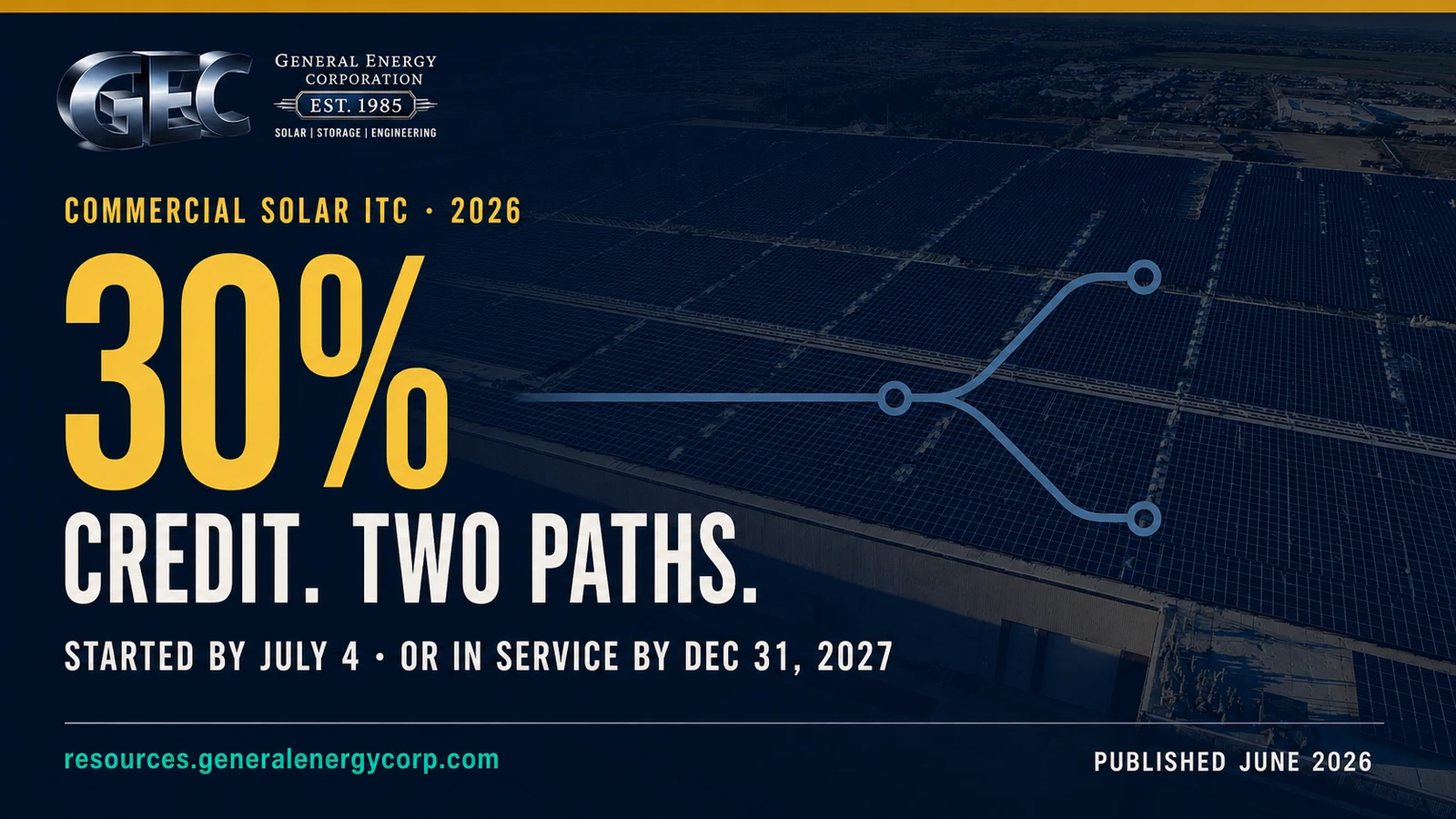
- Federal Investment Tax Credit: 30 percent of project cost, plus the 10 point Energy Community bonus where the address qualifies, which is most of Illinois, for a 40 percent credit. The detail lives in the Energy Community bonus guide. The credit remains fully available: projects that began construction by July 4, 2026 have until the end of 2030 to be placed in service, and projects starting now must be placed in service by December 31, 2027, covered in the safe harbor guide.
- Illinois Shines SRECs: Fifteen years of solar renewable energy credit revenue through the state Illinois Shines program, contracted per the program's current block pricing.
- MACRS depreciation: Accelerated depreciation on the system basis, with first-year bonus depreciation, for owners with the tax position to use it.
Captured together, the ComEd rebate plus the 40 percent federal credit plus depreciation recover a large share of project cost in the first year, with SREC revenue arriving over the fifteen years that follow. The reason GEC discloses each incentive on its own line, with its own qualifier, is that none of them apply automatically. Energy Community status is verified at the address, the rebate is confirmed at the correct commercial rate, and SREC pricing is taken from the current block. The complete federal walkthrough lives in the safe harbor guide, and the full Illinois picture lives on the Incentives and Safe Harbor pillar.
What is not eligible for the rebate?
- Facilities interconnected on or before August 11, 2022. The rebate applies to distributed generation interconnected to ComEd's system after that date. Older systems do not qualify.
- Systems over the 5 MW cap. The distributed generation facility must have a total rated capacity at or below 5,000 kW. GEC's commercial scope at or below 1.5 MW AC is always well under this line.
- Facilities outside ComEd territory. The rebate is a ComEd program. A facility in Ameren Illinois territory looks to Ameren's own distributed generation rebate instead.
- Standalone storage with no qualifying solar. Under the current tariff the battery must be paired with a qualifying distributed solar facility. Standalone storage is not eligible today.
- Systems without a qualifying smart inverter. The system has to interconnect through a smart inverter on the Illinois approved inverter list. The grid-support capability is part of what the rebate is paying for.
How GEC captures the rebate for your facility
GEC is an engineering-first EPC, licensed in 10 states and building nationwide, with its deepest roots in Illinois, where it has engineered commercial energy systems since 1985. On a ComEd-territory project the rebate is not a line item added at the end. It is engineered in from the start, because the inverter selection, the interconnection filing, and the system rating are what determine whether the rebate is captured cleanly and at the correct commercial rate. GEC runs the interconnection through a smart inverter on the approved list, files the DG Rebate application with the documentation ComEd needs to approve it on the first pass, and sizes the system so the solar and storage rebates land together with the federal credit and Illinois Shines.
The work shows up in real projects in ComEd territory. GEC engineered the 802 kW rooftop solar system for Core Pipe Products in Carol Stream, in DuPage County, an Energy Community on the current IRS list, the kind of commercial facility this rebate is written for. The Carol Stream page and the rest of the Illinois market pages show how the rebate and the federal credit land market by market. The assessment is where it starts: one recent utility bill per meter and the facility address, and GEC returns a system sized to the load, the ComEd rebate at the correct rate, and the verified federal credit, with nothing blended together. For strong projects, GEC can fund the federal safe-harbor commitment through a letter of intent that does not commit the customer to build.
Get Your ComEd Rebate Modeled
Same starting point as everything else on this page: one recent bill per meter plus the facility address. You get back a load-sized system design, the rebate figured at the $250 commercial rate, Energy Community verification for the 40 percent credit, and a projection you can hand to your CFO. Nothing about it commits you to build.
Frequently Asked Questions
This guide is general information, not tax or legal advice. ComEd Rider DG Rebate amounts, eligibility, and process are governed by the tariff in effect at the relevant time and by ComEd's published terms, and rebate proceeds may be taxable. Figures shown are representative. Confirm current rebate values, eligibility, and tax treatment with ComEd, your tax advisor, and the primary sources linked here before acting. How this guide was made: written and reviewed by the GEC team named above. We use AI tools for research and production support, and every figure is checked against the primary sources listed before publish.
Continue the series
- The 40 percent federal credit: The Energy Community bonus, how most of Illinois reaches a 40 percent commercial solar credit, the largest layer on top of the ComEd rebate.
- The deadline that locks the credit: Commercial solar tax credit safe harbor in 2026, how about 5 percent of project cost preserves the federal credit the rebate combines with.
- Up to the hub: Incentives and Safe Harbor, the pillar that ties every Illinois program together.
- Your market: Illinois city pages, the rebate and the rest of the package, market by market.
References
- 1 ComEd, Solar and distributed generation rebates (program page and Rider DG Rebate terms). comed.com solar rebates
- 2 ComEd Rider DG Rebate, Terms and Conditions (rate by customer class, 5 MW cap, smart inverter and pairing requirements, effective and interconnection dates). ComEd published tariff document.
- 3 DSIRE, ComEd Distributed Generation Rebate, program 22233. programs.dsireusa.org/system/program/detail/22233
- 4 Illinois Public Utilities Act, Section 16-107.6 (statutory basis for the rebate). 220 ILCS 5/16-107.6.
- 5 ComEd Rider SPWS Rebate, Solar Paired With Storage (Illinois Commerce Commission tariff filing, under Public Act 104-0458). icc.illinois.gov filing
- 6 Illinois Shines, DG Purchase Disclosure Form (net-metering, rebate, and storage participation language). illinoisshines.com/dg-purchase-disclosure-form
- 7 Illinois Shines, Illinois Adjustable Block / SREC program. illinoisshines.com
- 8 IRC Section 48E (clean electricity investment credit, the federal credit the rebate combines with). law.cornell.edu/uscode/text/26/48E