The Energy Community bonus adds 10 percentage points to the federal commercial solar credit, taking it from 30 percent to 40 percent of total system cost under Section 48E. On the current IRS list, 79 of Illinois' 102 counties qualify, including every county in the Chicago metro area. The bonus is claimed by location, verified at the facility address, and a project that establishes its begin-construction date while its location qualifies keeps the bonus even if the IRS lists later change, whether that date falls before or after the July 4, 2026 begin-construction deadline that separates the two placed-in-service paths. This guide covers what the bonus is, the three ways a site qualifies, how to verify an address, why most of Illinois is covered, and what the extra 10 points are worth.
Fast Facts
- The short version: If your facility sits in an IRS-designated Energy Community, your federal solar credit is 40 percent instead of 30 percent. On the current IRS list, 79 of 102 Illinois counties qualify. GEC verifies your address as part of the free assessment.
- Program: Energy Community bonus credit under Section 48E, created by the Inflation Reduction Act.
- What it adds: 10 percentage points on top of the 30 percent commercial solar credit for projects that meet prevailing wage and apprenticeship requirements or come in under 1 MW AC. The bonus rides with the credit and transfers with it under Section 6418.
- Three ways a site qualifies: A coal closure census tract (mine closed after 1999 or coal plant retired after 2009, including adjoining tracts), a statistical area with historic fossil fuel employment and prior-year unemployment at or above the national average, or a brownfield site.
- Illinois on the current list: 79 of 102 counties qualify under IRS Notice 2025-31, including Cook, DuPage, Will, Lake, Kane, McHenry, Kendall, Grundy, and DeKalb, every Illinois county in the Chicago metro.
- When status is tested: At the placed-in-service date. But under IRS Notice 2023-29, a project that begins construction while its location qualifies keeps Energy Community status through placement in service, even if the lists change.
- How to verify: The federal mapping tool is a planning aid only. The IRS appendix lists control. GEC runs the address against the current appendices and documents the result.
- Primary sources: IRS Notice 2023-29. IRS Notice 2025-31 and its Appendix 3 county list. IRS energy community FAQ. Instructions for Form 3468.
- 1 The Energy Community bonus takes the federal commercial solar credit from 30 percent to 40 percent of project cost. On a $1,000,000 system, that is an extra $100,000.
- 2 Qualification is about the address, not the business. Coal closure tracts and qualifying statistical areas are mapped by the IRS in published lists. Most of Illinois is on them: 79 of 102 counties, including the entire Chicago metro.
- 3 Status is tested when the system is placed in service, but beginning construction locks it. A project that begins construction while its location qualifies keeps the bonus under IRS Notice 2023-29, even if the annual list update later drops the area.
- 4 The IRS refreshes the statistical-area list every year using the prior year's unemployment data, so counties can move on and off. Establishing a begin-construction date while a location qualifies locks the bonus at that moment, whether the date falls before or after July 4, 2026, the deadline that separately determines whether a project has until 2030 or December 31, 2027 to be placed in service. For strong projects, GEC funds that step through a letter of intent.
The four-click read
Four things to know about the 40 percent credit
The whole bonus in four cards. Each links to the section that proves it.
What the bonus adds
10 percentage points on the federal solar credit for facilities in an IRS-designated Energy Community. 30 percent becomes 40 percent of total system cost.
How it worksDoes my address qualify
Qualification runs on IRS lists: coal closure census tracts and statistical areas with fossil fuel history and elevated unemployment. The lists are published, and GEC checks your address against them as part of the free assessment.
Verify an addressThe Illinois map
79 of 102 Illinois counties qualify on the current IRS list, including every county in the Chicago metro. That is why 40 percent, not 30, is the working number for most Illinois commercial solar.
Why Illinois qualifiesHow the bonus locks in
The annual list refresh can move counties off. Establishing a begin-construction date while your location qualifies keeps the bonus under IRS Notice 2023-29, whether that date falls before or after July 4, 2026, the deadline that separately sets the 2030 versus December 31, 2027 placed-in-service window.
The lock-in ruleWhat is the Energy Community bonus?
The Energy Community bonus is a location-based addition to the federal commercial solar Investment Tax Credit, created by the Inflation Reduction Act. A solar project built at a facility inside an IRS-designated Energy Community earns 10 extra percentage points on the credit: 40 percent of total system cost instead of 30 percent. The idea behind it is straightforward. Places that historically hosted coal mines, coal plants, and fossil fuel jobs get a stronger incentive to host the next generation of energy projects.
The full 10 points apply when the project meets federal prevailing wage and apprenticeship requirements or has a maximum net output under 1 MW AC, the same conditions that set the base credit at 30 percent. Projects that meet neither condition receive a 2 point bonus instead, per the IRS instructions for Form 3468. GEC builds to prevailing wage and apprenticeship standards on commercial projects, so the working number is the full 10. The bonus is computed as part of the credit itself, which means it transfers for cash along with the credit under Section 6418 if the owner cannot use it directly, and it survives for any project regardless of when it establishes its begin-construction date, before or after July 4, 2026, under the current credit termination rules.
What are the three ways a site qualifies?
The IRS recognizes three categories of Energy Community, defined in Notice 2023-29 and updated through annual list notices. A facility needs to sit in just one of them.
The three Energy Community categories
| Category | What qualifies | Geographic level | Where it is listed |
|---|---|---|---|
| Coal closure | A census tract where a coal mine closed after Dec 31, 1999 or a coal-fired generating unit retired after Dec 31, 2009, plus every directly adjoining tract | Census tract | IRS notice appendices (currently Notice 2025-31) |
| Statistical area | An MSA or non-MSA with 0.17 percent or more historic fossil fuel employment (or 25 percent fossil fuel tax revenue) and prior-year unemployment at or above the national average | County, via its MSA or non-MSA | IRS notice appendices, refreshed annually |
| Brownfield | A site whose reuse is complicated by the presence or potential presence of contamination under the federal CERCLA definition | Individual site | Not mapped. Qualified site by site, with a safe-harbor process |
The two mapped categories do the heavy lifting for Illinois commercial facilities. The statistical-area category qualifies whole counties at a time through their metro or non-metro groupings, and the coal closure category adds tract-level coverage around every closed mine and retired plant. Brownfield qualification is real but site-specific: it requires assessment documentation rather than a map lookup, and a site contaminated only by petroleum generally does not qualify under the federal definition.
Is my facility in an Energy Community?
The answer comes from a document, not a guess. The federal interagency working group publishes a mapping tool built on Department of Energy data, hosted through energycommunities.gov, and it is the fastest way to get a first read on an address. It is also, by the IRS's own language, a planning aid that cannot be relied on to substantiate a tax position. The lists that control are the appendices the IRS publishes with each energy community notice, currently Notice 2025-31, which carries the county-level statistical-area list and the coal closure tract list as downloadable files.
Done properly, verification takes three steps. First, resolve the facility address to its census tract and county using the Census Bureau's geocoder. Second, check the county against the current statistical-area appendix. Third, if the county is not on that list, check the tract and its neighbors against the coal closure appendix, because tract-level coverage reaches into counties the statistical-area list misses. GEC runs all three steps as part of the free site assessment and documents the result against the current notice, so the address that goes into the project file is the address the IRS rules actually support. The map gets a look. The appendices get the signature.
Get Your Address Verified
Send one recent utility bill per meter and your facility address. GEC verifies Energy Community status against the current IRS lists, models the full federal and Illinois package, and returns an indicative design with a per-incentive projection, usually within a week. No commitment to move forward.
Why does most of Illinois qualify?
Illinois spent a century mining coal and burning it for power, and the qualification rules were written for exactly that history. On the current IRS list, 79 of Illinois' 102 counties qualify as Energy Communities under the statistical-area category alone, verified directly against the Appendix 3 county file published with Notice 2025-31. That includes every Illinois county in the Chicago metro area: Cook, DuPage, Will, Lake, Kane, McHenry, Kendall, Grundy, and DeKalb. It also includes the Springfield, Decatur, Danville, Kankakee, and Carbondale-Marion metros, plus 62 rural counties across the state's non-metro groupings.
The coal closure category layers tract-level coverage on top. Illinois retired coal capacity at scale over the past fifteen years: the Will County Generating Station in Romeoville in 2022, Waukegan in 2022, and the Hennepin, Havana, Duck Creek, and Coffeen plants in 2019, on top of Chicago's Fisk and Crawford stations in 2012. More than twenty Illinois coal mines have closed since 2000. Every one of those closures creates qualifying census tracts, including the tracts that directly adjoin them, which is how parts of the 23 counties outside the statistical-area list still qualify at specific addresses.
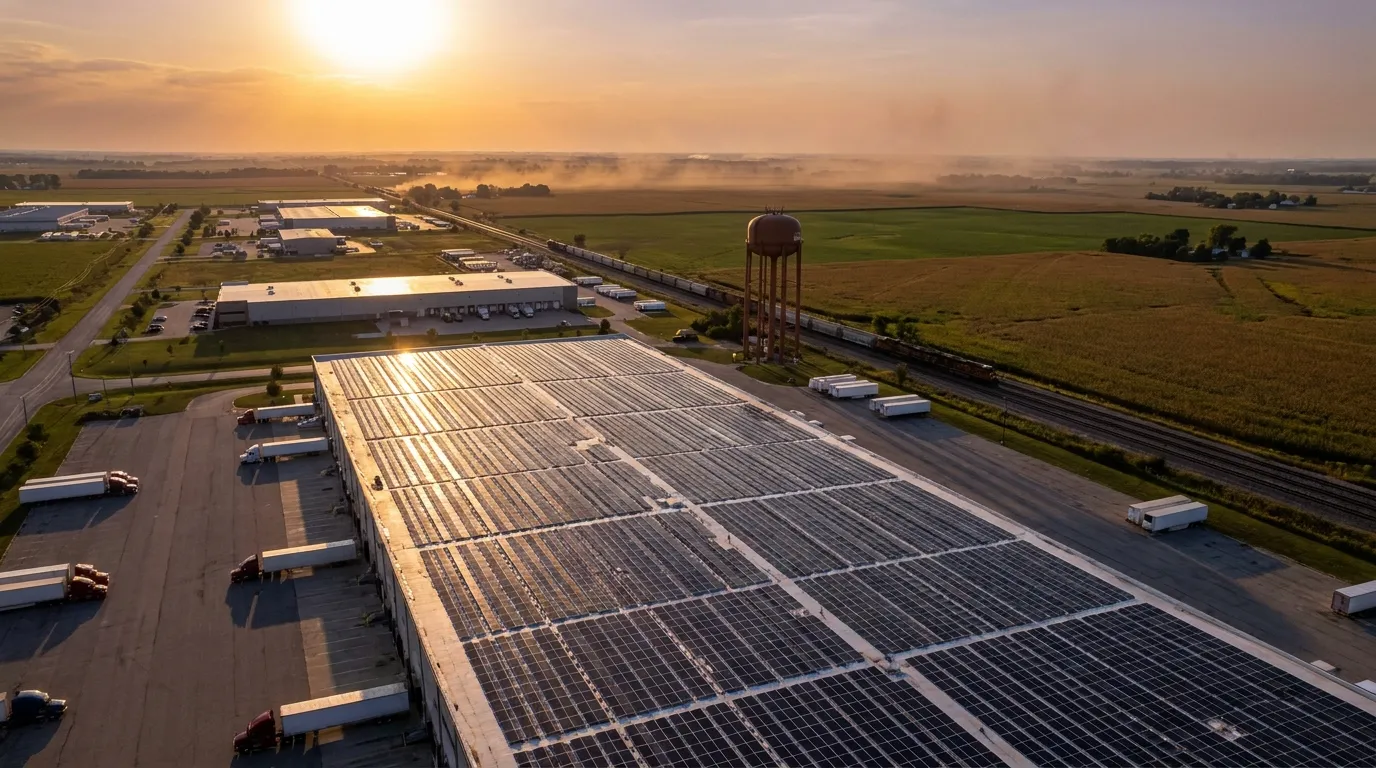
This is not theoretical for GEC projects. Core Pipe Products' 802 kW rooftop system in Carol Stream sits in DuPage County, which qualifies on the current list, and the project captured the 10 point bonus on top of the base credit. The Lisle and Carol Stream market pages carry the same verified status, and the rest of the Illinois city pages show how the bonus lands market by market. The honest caveat: a handful of metros, including Peoria, Rockford, Champaign-Urbana, Bloomington, and the Illinois side of the St. Louis metro, are not on the current statistical-area list, mostly because their unemployment ran below the national average. Facilities there check the coal closure tracts, and some qualify that way. The address decides, which is why GEC verifies every project against the lists rather than rounding the state up to 100 percent.
With 79 of 102 counties qualifying, including the entire Chicago metro, the 40 percent credit is the default planning number for Illinois commercial solar, confirmed at the address before it goes in a proposal. GEC models every Illinois project both ways only when the address verification says it has to.
What is the extra 10 percent worth?
On the credit alone, the bonus is worth one third more than the base federal benefit, dollar for dollar against project cost. The table shows the spread at representative Illinois commercial scale.
The 30 versus 40 percent credit at representative 2026 pricing
| System size | Typical project cost | 30% credit | 40% credit | Bonus dollars |
|---|---|---|---|---|
| 200 kW rooftop | ~$400,000 | ~$120,000 | ~$160,000 | ~$40,000 |
| 500 kW rooftop | ~$1,000,000 | ~$300,000 | ~$400,000 | ~$100,000 |
| 1 MW rooftop or ground | ~$2,000,000 | ~$600,000 | ~$800,000 | ~$200,000 |
| 1.5 MW AC rooftop or ground | ~$3,000,000 | ~$900,000 | ~$1,200,000 | ~$300,000 |
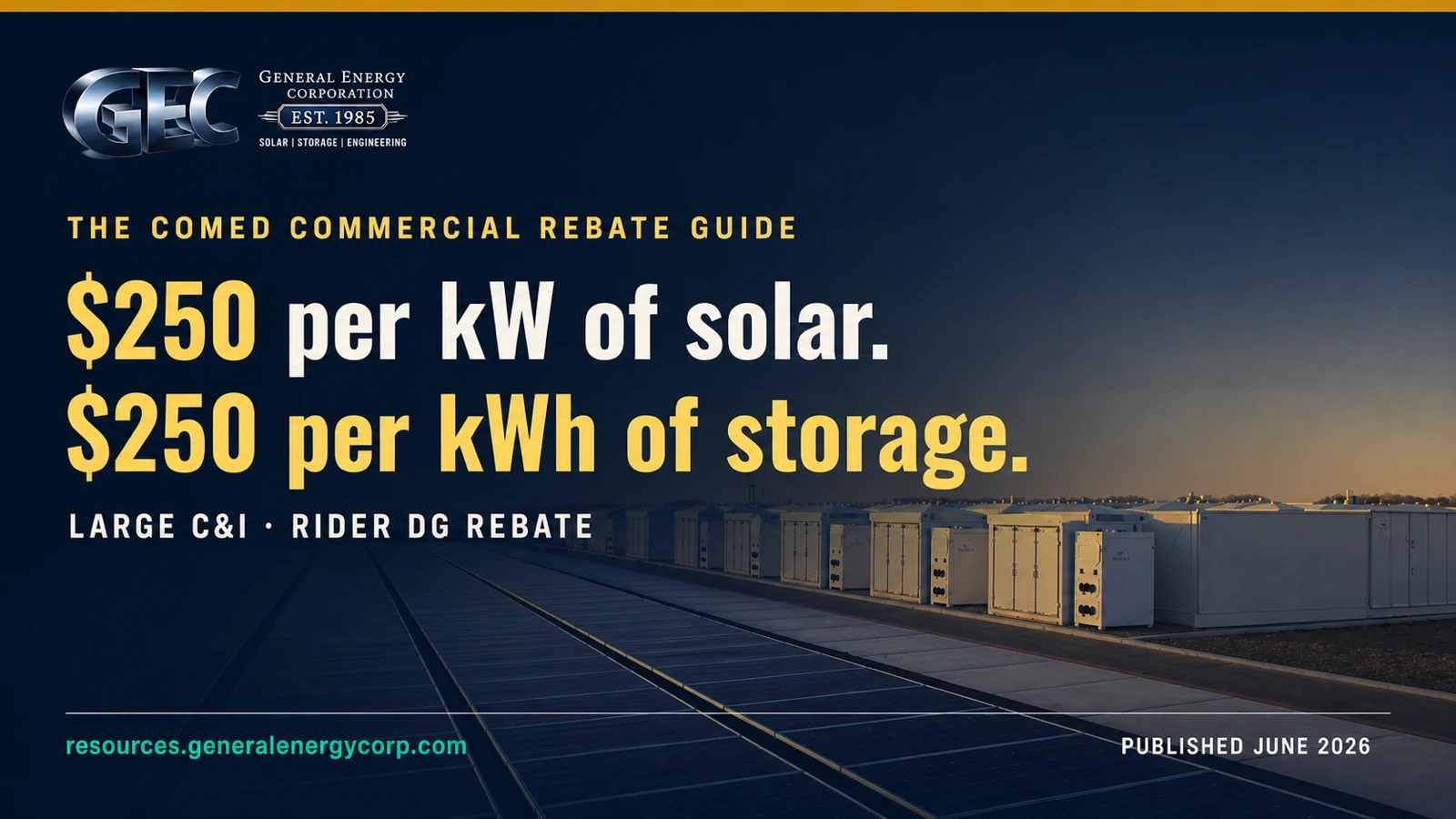
Representative figures only. Actual cost depends on roof type, electrical infrastructure, and whether storage is integrated. For a taxable business, the bonus compounds with depreciation: at the 40 percent credit, the federal credit plus 100 percent first-year bonus depreciation recover roughly 57 percent of project cost in year one, versus about half at the base 30 percent, for owners with the tax position to use it. Illinois Shines SREC revenue and the ComEd or Ameren rebate at $250 per kW of nameplate generating capacity apply on top, each verified and captured individually. The complete walkthrough of the federal math lives in the commercial solar tax credit safe harbor guide, and the Illinois program detail lives on the Incentives & Safe Harbor pillar.
Does the 1 MW line change the bonus?
Two size lines matter, and they do different jobs. Under 1 MW AC, the full 10 point bonus applies without the prevailing wage and apprenticeship tests. From 1 MW AC up to the 1.5 MW AC level GEC engineers to, the full bonus applies when those labor requirements are met, and GEC manages that compliance as part of the build. The 1.5 MW AC line is a different rule entirely: it is the begin-construction threshold that keeps a project on the simple 5 percent safe-harbor method, covered in the safe harbor guide and the June 6 court ruling breakdown. Neither line shrinks the Energy Community bonus on a properly built GEC project.
How do you lock the bonus in?
Energy Community status is tested on the day the system is placed in service. That sounds like a problem, because the statistical-area list refreshes every year using the prior year's unemployment data, and a county that qualifies today can drop off a future list if its unemployment falls below the national average. The IRS solved this in Notice 2023-29: a project that establishes its begin-construction date while its location qualifies keeps that qualification through the placed-in-service date, regardless of later list updates. Establish that date while your county is on the list and the 40 percent is locked, whether the date falls before or after July 4, 2026.
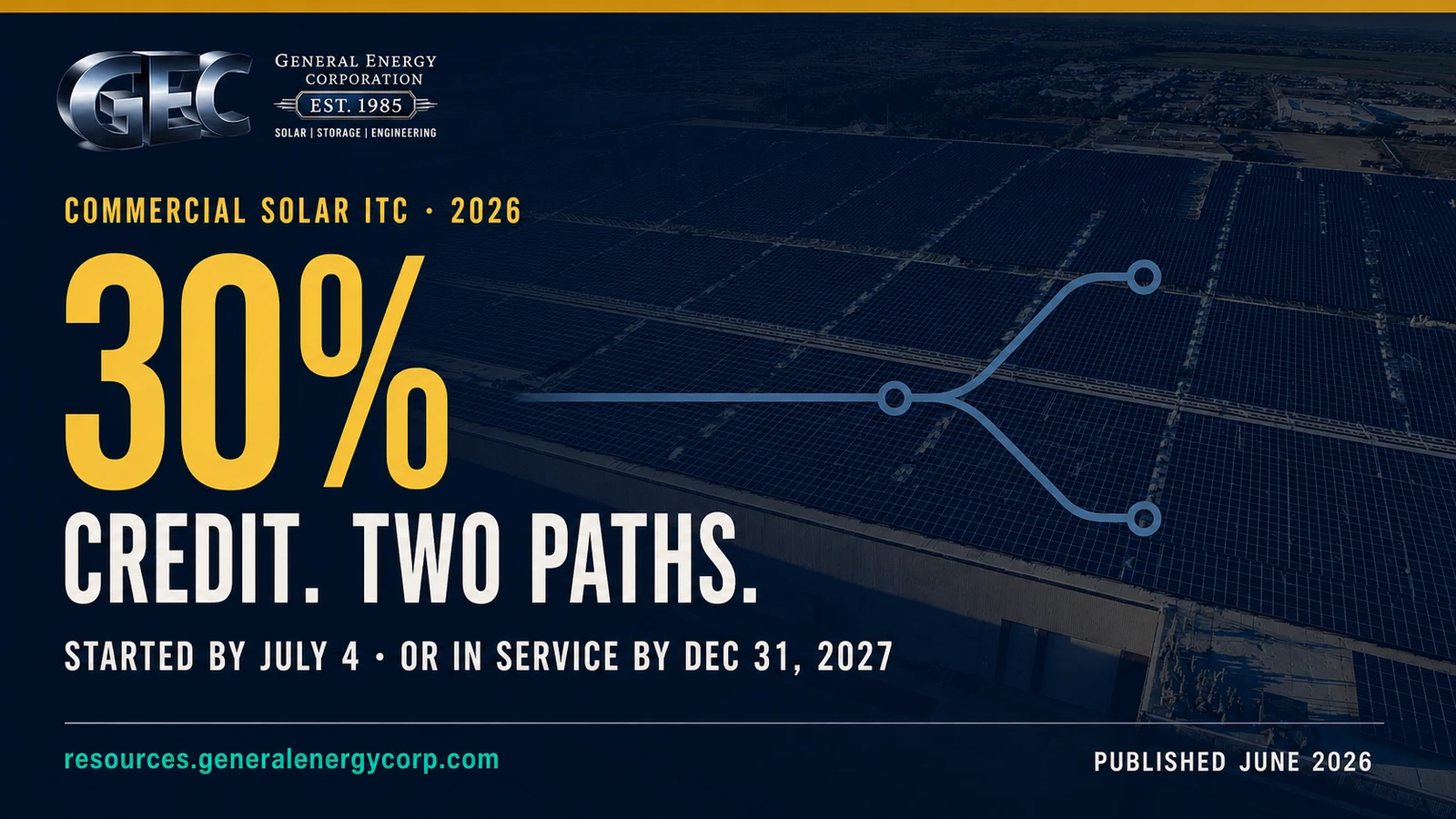
The begin-construction step is the hinge for both halves of the credit, but the two halves run on separate clocks. Establishing a begin-construction date by July 4, 2026 preserved the 30 percent base credit under the longer runway through the end of 2030; establishing it after July 4, 2026 preserves the same 30 percent credit on the December 31, 2027 placed-in-service deadline instead. Either way, establishing that date while the facility sits in a qualifying Energy Community locks the 10 point bonus at the same moment. One commitment, both numbers. For systems at or below 1.5 MW AC, committing about 5 percent of project cost under a binding contract is what that takes, and for strong projects GEC puts up its own capital to fund it, secured by a letter of intent that does not commit you to build.
Lock 40 Percent While Your County Qualifies
One recent utility bill per meter and your facility address. GEC verifies your Energy Community status against the current IRS lists, documents the begin-construction date on the 5 percent path, and for strong projects funds the early commitment through a letter of intent. No commitment to build.
Frequently Asked Questions
This guide is general information, not tax or legal advice. Energy Community qualification depends on the facility's specific location and the IRS lists in effect at the relevant time, and the statistical-area list updates annually. Figures shown are representative. Confirm eligibility and values with your tax advisor and against the primary sources linked here before acting.
Continue the series
- The deadline half of the story: Commercial solar tax credit safe harbor in 2026, how about 5 percent of project cost preserves the credit this bonus rides on.
- The June 6 ruling: Court vacates IRS Notice 2025-42, what changed in the begin-construction rules and what did not.
- Up to the hub: Incentives & Safe Harbor, the pillar that ties every Illinois program together.
- Your market: Illinois city pages, the bonus and the rest of the package, market by market.
References
- 1 IRS, Frequently asked questions for energy communities. irs.gov/credits-deductions/frequently-asked-questions-for-energy-communities
- 2 IRS Notice 2023-29 (energy community categories and the begin-construction rule). irs.gov/pub/irs-drop/n-23-29.pdf
- 3 IRS Notice 2025-31, Internal Revenue Bulletin 2025-28 (current annual lists). irs.gov/irb/2025-28_IRB
- 4 IRS Notice 2025-31, Appendix 3 county list (statistical-area energy communities). irs.gov/pub/irs-drop/n-25-31-appendix-3.xlsx
- 5 IRS, Instructions for Form 3468 (energy community bonus computation). irs.gov/instructions/i3468
- 6 Energy Communities IWG Site Review Tool, DOE/NETL dataset record (the federal mapping tool, reached via energycommunities.gov). osti.gov/biblio/2396854
- 7 U.S. Census Bureau geocoder (address to census tract). geocoding.geo.census.gov
- 8 ILMines Wiki, University of Illinois (Illinois coal mines and power plants under the Inflation Reduction Act). ilmineswiki.web.illinois.edu
- 9 IRC Section 48E (clean electricity investment credit). law.cornell.edu/uscode/text/26/48E