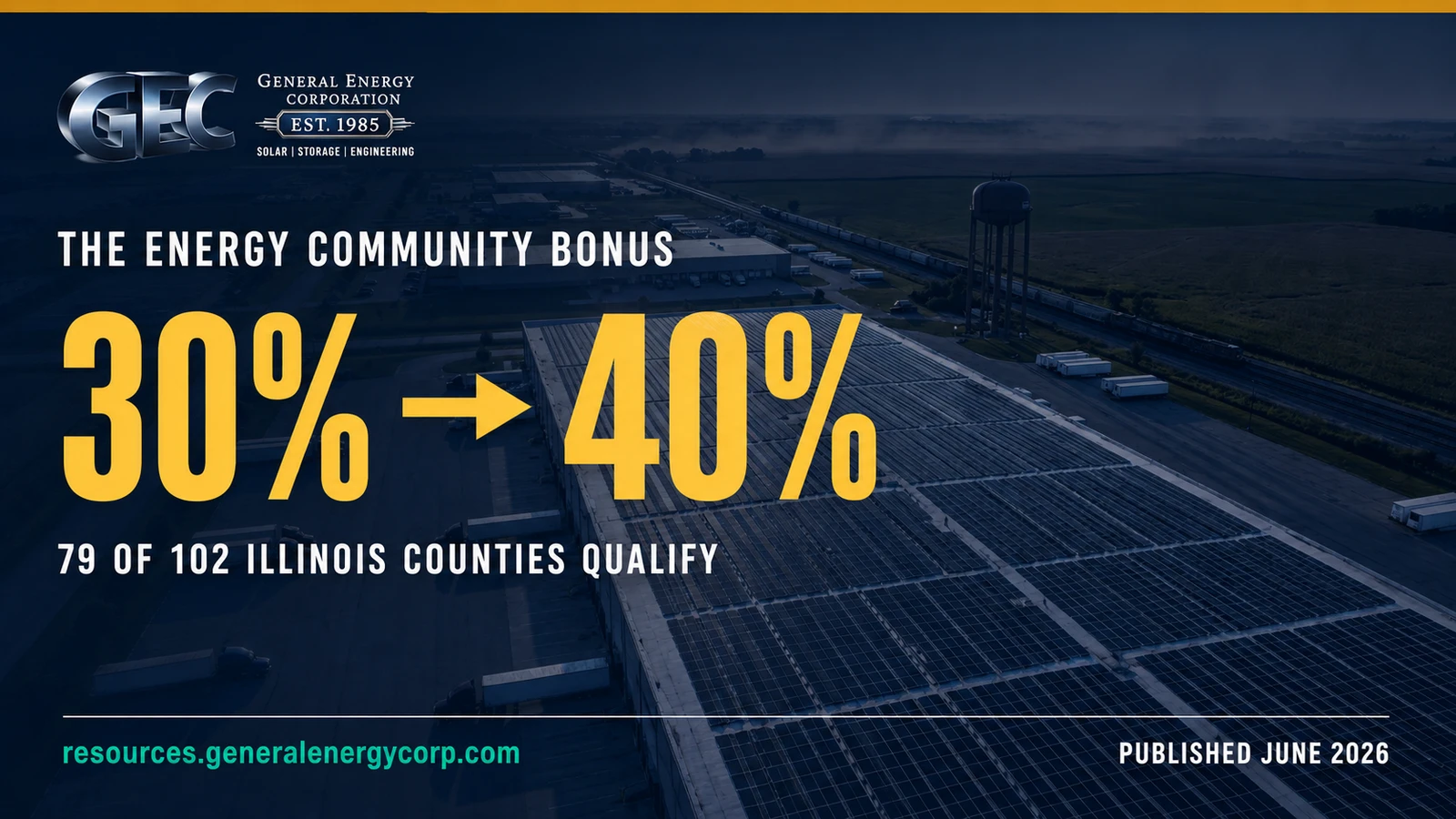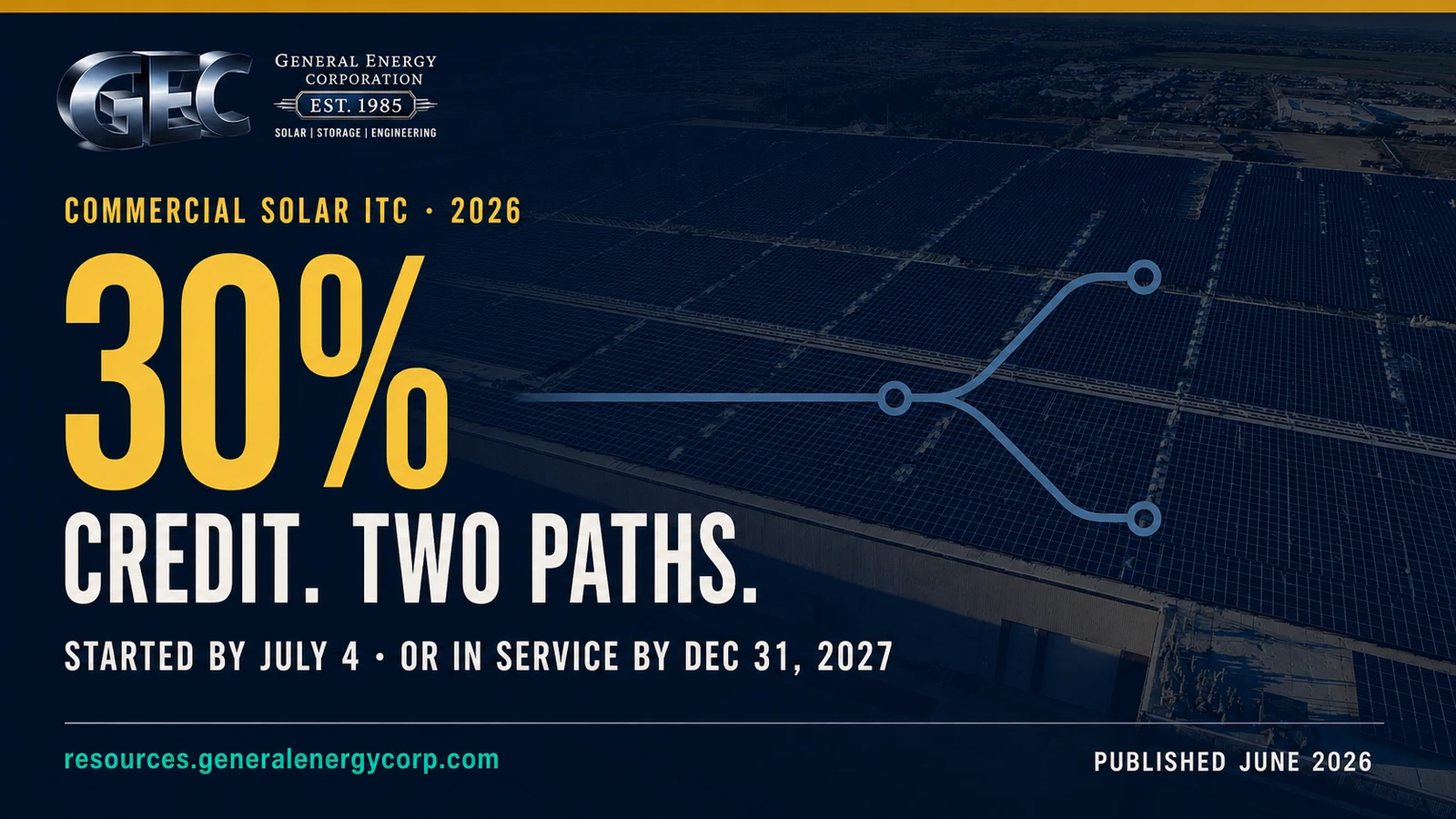
The federal solar Investment Tax Credit is still 30 percent in 2026, 40 percent in a qualifying Energy Community, and the July 4, 2026 begin-construction deadline has already passed. That date decided which placed-in-service runway a project gets, not whether the credit exists. Illinois manufacturers who established a begin-construction date by July 4, 2026 keep the full 30 percent federal ITC and have until the end of 2030 to build. Manufacturers starting the conversation now still get the same credit, the same 10 percent Energy Community bonus where their facility qualifies, and the Illinois Shines SREC vintage available today. The difference is the placed-in-service date: December 31, 2027 instead of 2030, roughly eighteen months from a decision today.
The July 4, 2026 federal begin-construction deadline for the longer, four-year placed-in-service runway under Section 48E has passed. It did not end the credit. A manufacturer starting a project now establishes its own begin-construction date and has until December 31, 2027 to place the system in service. That is the real deadline for a project starting today, and the realistic build window is long enough for a typical manufacturer install if the engineering assessment starts soon.
- 1 The July 4, 2026 begin-construction deadline has passed. It locked in the longer, 2030 placed-in-service runway for projects that started by then. It did not close the 30 percent solar ITC for anyone else.
- 2 A manufacturer starting a project today must place the system in service by December 31, 2027 to claim the credit, an eighteen-month-class runway rather than the multi-year window available to projects that started earlier. The credit percentage, 30 percent, 40 percent in a qualifying Energy Community, is unchanged.
- 3 Establishing a begin-construction date does not commit the manufacturer to building. It documents the project's timeline and, for projects already underway before July 4, it is what secured the 2030 runway.
- 4 The realistic path from a cold start to a documented, engineered project is about 4 weeks: site visit, engineering assessment, decision meeting, then a design and construction schedule built to reach energization before December 31, 2027.
Why July 4, 2026 Still Matters (And Why It Is Not the End of the Story)
The One Big Beautiful Bill Act (OBBB), signed into law in 2025, established July 4, 2026 as the federal begin-construction deadline that determined which placed-in-service runway a commercial solar project gets under Section 48E. Projects that established their begin-construction date by that day keep the current 30 percent credit value and have until the end of 2030 to be placed in service. Projects establishing their begin-construction date after July 4, 2026 keep the same 30 percent credit. They must be placed in service by December 31, 2027 instead, per IRS Notice 2025-42 and Section 48E(e)(4).
For a project that already established its begin-construction date by July 4, 2026, the three-year continuity safe harbor gives it until the end of 2030 to be placed in service, enough time to negotiate landlord consent on a leased facility, work through a CFO-led financing decision, coordinate interconnection studies with ComEd or Ameren, and stage construction without the credit calendar dictating the project timeline. For a manufacturer starting today, the runway is shorter, December 31, 2027, but the credit itself is identical.
For Illinois manufacturers specifically, the federal timeline sits alongside three other moving pieces:
- Illinois Shines is in a high-payment block in 2026. New commercial systems registered in the current vintage are earning roughly 34 to 43 percent more per SREC than 2024 vintages. The Adjustable Block Program fills in waves, not on a fixed calendar.
- PJM Interconnection capacity prices jumped 11x at the 2025 capacity auction. Clearing prices moved from $28.92 to $329.17 per megawatt-day, materially raising the demand-charge portion of commercial bills across the ComEd footprint.
- The Clean and Reliable Grid Affordability Act (CRGA) was signed into Illinois law in 2025. Grid reliability is now a legal mandate at the state level, accelerating the timeline for adding behind-the-meter generation to relieve grid stress.
Start the Assessment Now
GEC can complete an Illinois site assessment, deliver an engineering report, and document the project's begin-construction date so the December 31, 2027 placed-in-service timeline is clear from day one.
What Counts as a Begin-Construction Date (The 5% Rule, in Plain English)
The IRS recognizes two paths to establishing a begin-construction date for solar Investment Tax Credit purposes. Establishing that date by July 4, 2026 is what secured the longer, 2030 placed-in-service runway for projects already underway. For a manufacturer starting today, the credit is available either way. The operative date is simply December 31, 2027, placed in service. For the plain-English explainer on how the commercial credit survived 2026, how it differs from the residential credit that ended, and what each begin-construction method requires, see the commercial solar safe harbor guide.
Path 1: The 5% Cost Method
A taxpayer establishes a begin-construction date by paying or incurring at least 5 percent of the total project cost under a binding written contract. For a 500 kW commercial solar system priced around $1,000,000, that is approximately $50,000. For a 1.5 MW system at $3,000,000, the commitment is approximately $150,000. This is the test that determined which projects secured the 2030 placed-in-service runway by establishing their begin-construction date on or before July 4, 2026.
What 'paid or incurred' actually means: equipment has to be paid for or under a binding written contract that meets specific IRS continuity-of-construction requirements. Vague intent does not qualify. A purchase order or invoiced deposit on solar modules, inverters, or racking that crosses the 5 percent threshold does qualify.
Path 2: The Physical Work Test
Alternatively, a taxpayer can establish a begin-construction date through physical work of a significant nature. Excavation for solar racking footings, installation of structural racking components, the start of switchgear or transformer work for the system. The threshold is qualitative rather than quantitative, but the IRS expects continuous progress from that point forward. For most commercial rooftop and ground-mount projects at or below 1.5 MW AC, the 5 percent cost method is the cleaner, more defensible path.
Establishing a begin-construction date is not the same as signing a construction contract and breaking ground. It does not commit the manufacturer to building. It commits a defined cost or defined scope of physical work and clarifies which placed-in-service deadline applies.
What 5% Looks Like at Typical Illinois Manufacturer Scale
Project cost varies by site complexity, roof type, electrical infrastructure, and whether battery storage is integrated. The table below shows representative project economics for commercial solar systems sized to typical Illinois manufacturer load profiles. Actual numbers depend on the site assessment.
Representative project economics for Illinois commercial solar (2026 pricing)
| System Size | Typical Project Cost | 5% Begin-Construction Figure | Federal ITC at 30% | Placed-In-Service Window |
|---|---|---|---|---|
| 200 kW rooftop | ~$400,000 | ~$20,000 | ~$120,000 | By Dec 31, 2027 (new starts) |
| 500 kW rooftop | ~$1,000,000 | ~$50,000 | ~$300,000 | By Dec 31, 2027 (new starts) |
| 1 MW rooftop or ground | ~$2,000,000 | ~$100,000 | ~$600,000 | By Dec 31, 2027 (new starts) |
| 1.5 MW rooftop or ground | ~$3,000,000 | ~$150,000 | ~$900,000 | By Dec 31, 2027 (new starts) |
For a 100 to 500 employee Illinois manufacturer, the federal ITC is a meaningful line item. What gets preserved depends entirely on the facility. The 30 percent federal ITC applies in every case. The 10 percent Energy Community bonus applies only if the address sits in an IRS-designated Energy Community census tract. Illinois Shines SREC revenue depends on the program block available when the system registers. Utility rebates depend on whether the facility is in ComEd or Ameren territory. Bonus depreciation depends on the manufacturer being a taxable business with tax appetite to absorb the credit. None of these apply automatically. Each one requires verification at the project and address level before it shows up in actual numbers.
The point of documenting a begin-construction date is not to lock in an aggregate claim about project economics. It is to establish, clearly and on the record, which placed-in-service deadline the federal ITC portion of the project is on.
Get the Number for Your Facility
Takes a minute, straight to the engineering team. Personal reply within one business day, and no commitment to move forward.
Who Owns This Decision at a 100 to 500 Employee Manufacturer
In most privately-held Illinois manufacturers of this size, three roles share the decision:
- President or CEO Owns the capital allocation decision and the strategic frame. Typically the final approver. Cares about total cost of ownership, operational continuity, and the long-term cost trajectory of the facility.
- Chief Operating Officer or VP Operations Owns the facility, the energy bills, and the operational disruption assessment. Often the first internal champion. Cares about reliability, plant downtime risk, and whether the project complicates day-to-day operations.
- Chief Financial Officer or Controller Owns the financial structuring decision: cash purchase, capital lease, operating lease, PPA, or ITC transferability under Section 6418. Cares about cash flow, balance sheet impact, and tax appetite to absorb the credit directly versus selling it.
Decisions of this nature in privately-held manufacturers usually move on the President's timeline, with the COO providing the operational green light and the CFO modeling the financial structure. When all three are aligned, the project moves. Because the placed-in-service deadline for a new start is now December 31, 2027 rather than a matter of weeks, there is real room for that alignment to happen without rushing the decision, provided the engineering assessment starts soon enough to leave the build itself a full runway.
That is why the realistic starting point is not 'we will decide next quarter.' It is 'we will start the assessment this month,' so design, interconnection, procurement, and construction all have room inside the runway that ends December 31, 2027.
Why 'We Looked at Solar Before' No Longer Holds
Most manufacturers who evaluated commercial solar before 2024 were looking at a materially different economic picture. The substantive changes since then:
- 10 percent Energy Community bonus (effective 2023 forward). Adds 10 percent to the federal ITC for projects sited in IRS-designated Energy Community census tracts. Many Illinois industrial corridors qualify, particularly downstate and in legacy coal regions. This bonus did not exist when most older proposals were prepared.
- Illinois Shines program revamp. The state REC program was overhauled with consumer-protection disclosures, payment reliability improvements, and per-vintage payment increases. The current commercial vintage pays 34 to 43 percent above 2024 levels.
- 100 percent bonus depreciation restored under OBBB. For taxable C&I businesses, this recovers an additional 20 to 26 percent of project cost in year one, added on top of the ITC.
- PJM capacity prices jumped 11x at the 2025 capacity auction. Demand-charge math today is materially different than it was 24 months ago. The system economics that did not pencil in 2022 often pencil now.
- CRGA Act signed into Illinois law in 2025. Grid reliability is now a legal mandate, adding pressure to bring generation online behind the meter and improving the regulatory backdrop for commercial solar.
The single sentence: the math has changed enough that a 2022 or 2023 evaluation is not a current evaluation. An older proposal should not be treated as authoritative on what the project economics look like today, and the July 4, 2026 deadline passing does not change that math either.
The Path From Today to December 31, 2027
For an Illinois manufacturer starting the conversation now, the realistic path looks like this:
- 1 Week 1. Site visit and energy bill submission. GEC pulls 12 months of interval data, reviews roof and electrical infrastructure, runs a preliminary incentive model, and verifies Energy Community status at the address using the DOE ArcGIS designated-area tool.
- 2 Week 2. Engineering assessment delivered. Structural review, electrical interconnection feasibility, indicative system design, project cost estimate, and modeled incentive capture across federal ITC, Energy Community bonus, Illinois Shines, utility rebate, and bonus depreciation.
- 3 Week 3. Decision meeting. President, COO, and CFO review the assessment together. Financing-structure options are walked through (cash purchase, capital lease, operating lease, ITC transferability under Section 6418). The board, ownership, or relevant approval body weighs the commitment against the rest of the capital plan.
- 4 Week 4 and beyond. Begin-construction date documented, then design, permitting, and construction to energization. The project's begin-construction date is documented through the 5 percent cost method or the physical work test, whichever applies. From that point, GEC sequences interconnection, procurement, and construction on a schedule built to reach energization before December 31, 2027.
This is the realistic sequence for a manufacturer that has not started the conversation yet. Because the operative deadline for a new start is December 31, 2027 rather than a fixed number of weeks, there is real room in the schedule, provided the first conversation happens soon enough that design, interconnection, procurement, and construction all fit inside the runway.
What the December 31, 2027 Deadline Means for Illinois Manufacturers
The federal credit did not disappear when July 4, 2026 passed. A manufacturer establishing a begin-construction date after that day is on the second path: the project must be placed in service by December 31, 2027 to claim the credit, an eighteen-month-class runway rather than the longer window available to projects that started earlier. A few things worth knowing about that runway:
- The credit percentage is unchanged, 30 percent base, 40 percent in a qualifying Energy Community, whether a project's begin-construction date falls before or after July 4, 2026.
- Battery storage paired with solar runs on its own Section 48E schedule and is not tied to the solar system's placed-in-service date, so a combined project's storage timing is modeled separately.
- The Illinois Shines Adjustable Block Program fills in waves and is not guaranteed at current rates indefinitely, which is a reason to register sooner rather than a reason tied to the federal deadline.
- PJM capacity charges continue to rise across the ComEd footprint, with no on-site mitigation in place until a system is energized.
None of this changes the value of the credit itself. The difference between the two paths is entirely about the calendar a project has to reach energization, not the incentive.
Start the Assessment This Month
The realistic timeline from first conversation to a documented begin-construction date is about 4 weeks. From there, GEC builds the schedule to reach energization before December 31, 2027. Start this week by sharing 12 months of utility bills.
A Real Illinois Anchor: Core Pipe Products in Carol Stream
Core Pipe Products is an Illinois manufacturer in Carol Stream that worked with General Energy Corporation on an 802 kW rooftop solar installation. The system offsets roughly 90 percent of the facility's electricity consumption and generates more than $76,000 in annual savings. Carol Stream sits in a confirmed Energy Community zone, which means the project captured the 10 percent EC bonus on top of the 30 percent base federal ITC.
Before committing, the CEO of Core Pipe Products had his CPA independently verify every number GEC presented. The numbers held against independent review. The point is not that every project looks like Core Pipe Products. System size, roof condition, load profile, utility territory, and Energy Community status all vary site to site. The point is that the project economics for Illinois manufacturers are specific, verifiable, and not theoretical.
Frequently Asked Questions
Where to Start If You Have Not Yet
The realistic starting point for any Illinois manufacturer who has not yet had a 2026 assessment done is straightforward: share 12 months of utility bills and a facility address. From those two inputs, an engineering team can verify Energy Community status, identify which incentive programs the facility qualifies for, and produce an indicative system design with project cost and a per-incentive credit projection within roughly a week.
If the assessment shows the project pencils, the project moves into design and the begin-construction date is documented as part of that process. If the assessment shows the project does not pencil, the engagement ends there. Exposure up to that point is limited to interconnection study and structural review fees, typically small relative to total project scale.
Get an Illinois Site Assessment
Takes a minute, straight to the engineering team. Personal reply within one business day, and no commitment to move forward.