The Brief Read
- Illinois manufacturers still have a reason to evaluate on-site solar: it can replace purchased electricity with power produced at the facility. The strongest starting point is your bill and operating schedule.
- For qualifying solar projects beginning construction now, the federal credit remains attainable when the project is placed in service by December 31, 2027. The 30% rate has eligibility conditions.
- Separate electricity used on site, exports, demand and capacity costs. A solar production estimate becomes a useful savings estimate only when it reflects the actual tariff and supplier contract.
- Use the bill-review worksheet below to bring facilities and finance into the same conversation. Start the site and utility review alongside the financial analysis.
Which parts of an Illinois electric bill can solar reduce?
Commercial solar can reduce the electricity an Illinois facility purchases when generation serves its operating load. Exported electricity receives the credit available under the applicable utility and supplier terms. Demand and capacity savings depend on peak timing and billing rules. Fixed customer charges generally remain. Model these parts separately to see the opportunity clearly.
For a manufacturer running production, ventilation, refrigeration or compressed-air equipment during daylight hours, on-site generation can serve a useful share of that load. The first question is how closely the proposed array’s output matches the plant’s actual electricity use. Twelve monthly bills establish the starting point. Interval data shows what happens within each day.
Read the bill in four parts
| Bill component | What solar can change | What to check |
|---|---|---|
| Purchased energy, measured in kWh | On-site solar can reduce electricity bought while the system is generating. | Consumption by time of day, time-of-use prices and the charges actually avoided. |
| Electricity exported to the grid | Exports can earn credits under the applicable net-metering or supplier arrangement. | Credit rate, eligible charges, settlement period and supplier terms. |
| Demand and capacity-related costs | Savings are possible when solar changes the specific peak or obligation used for billing. | Interval load, tariff peak definition, ratchets and contract treatment. |
| Fixed customer and service charges | These generally continue even as purchased electricity falls. | The charges that remain in the post-solar bill. |
The U.S. Department of Energy’s utility-rate guide explains why energy, demand and fixed charges need different treatment. Ask for a before-and-after bill model with those components visible. Dividing the entire annual bill by annual kWh produces a blended rate that may include charges the array will not change.
Why can two factories get different savings from the same solar output?
The timing of electricity use changes the value of solar production. A facility that uses more of its solar output on site can avoid more purchased electricity. A facility that exports more depends more heavily on its export credit. Annual generation alone cannot show that difference, even when the two arrays produce the same number of kWh.
Consider two hypothetical facilities producing 500,000 kWh of solar electricity a year. For illustration only, assume each on-site solar kWh avoids $0.08 of purchased-energy cost and each exported kWh receives $0.04. These are example inputs, not ComEd or Ameren rates. The calculation isolates energy value.
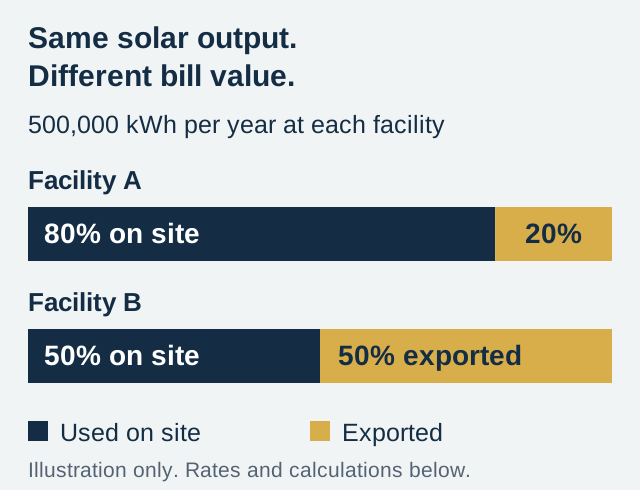
Illustrative annual energy benefit only
| Assumption or calculation | Facility A | Facility B |
|---|---|---|
| Annual solar production | 500,000 kWh | 500,000 kWh |
| Used on site | 400,000 kWh (80%) | 250,000 kWh (50%) |
| Exported | 100,000 kWh (20%) | 250,000 kWh (50%) |
| On-site use × $0.08/kWh | $32,000 | $20,000 |
| Exports × $0.04/kWh | $4,000 | $10,000 |
| Illustrative annual energy benefit | $36,000 | $30,000 |
The $6,000 difference comes entirely from when and where the electricity is used. Demand and capacity effects, project costs, maintenance, financing, taxes and incentives are excluded. This is not net savings or a payback calculation. A project model should replace both example rates with the facility’s actual marginal avoided charges and export terms.
This is why a useful design starts with the production schedule. Include weekend shutdowns, seasonal shifts, planned equipment and expected changes in occupancy. Right-sizing solar around those conditions helps finance assess an investment that fits the business.
Does solar lower manufacturing demand charges?
Solar can lower a demand charge when generation reduces the peak used to calculate that charge. A peak after sunset, a billing ratchet or a different measurement window can change the result. Compare interval consumption with modeled solar output and apply the actual tariff before assigning a demand-savings figure.
A National Renewable Energy Laboratory study of commercial demand charges explains why the outcome depends on the facility’s load and rate structure. For example, reducing midday consumption is useful, but it will not necessarily change a monthly billing peak set by an evening production shift.
Storage can be evaluated alongside solar when a measured peak-management or backup need supports it. Its value deserves its own operating model. GEC’s ComEd demand-charge guide explains the peak calculations, and the battery rebate and dispatch guide covers program participation and reserve planning.
What do today’s ComEd and Ameren markets mean for solar planning?
ComEd and Ameren Illinois operate in different wholesale markets: PJM and MISO, respectively. Capacity conditions help explain part of the electricity-cost environment, but a wholesale auction price is not a manufacturer’s retail rate. The useful solar question is which costs the facility’s current and next supply contracts allow it to reduce.
Use the market that serves your facility
| Territory | Current market context | Question for the bill review |
|---|---|---|
| ComEd / PJM | PJM’s July 14, 2026 auction set a $325/MW-day capacity price for the ComEd zone for the 2028/29 delivery year. | How does our supplier allocate capacity costs, and which peak or contract provisions could solar affect? |
| Ameren Illinois / MISO | MISO reported sufficient capacity in its 2026/27 auction. Its capacity framework is seasonal. | Which seasonal or hourly costs appear in our rate or supply contract, and how does solar production align? |
The PJM figure is from its 2028/29 auction results, a future delivery period. MISO’s 2026/27 auction announcement describes a different planning year and market structure. Neither result supports a blanket percentage increase or a universal solar-savings multiplier. A supply-contract renewal is a useful occasion to update a solar model using the actual terms.
Export treatment also matters. ComEd’s current net-metering FAQ describes supply-based credits for new small-load participants and continuing supply credits for larger commercial customers. Alternative suppliers may have different terms. For Ameren, use the Ameren Illinois net-metering tariff and the account’s applicable tariff. Keep on-site use and exported generation separate in the estimate.
Can a new Illinois commercial solar project still qualify for the tax credit?
Yes. For qualifying solar projects beginning construction after July 4, 2026, the federal clean electricity investment credit remains available when the project is placed in service by December 31, 2027. The IRS Form 3468 instructions explain this timing rule. An earlier qualifying construction start follows a separate analysis.
A qualifying project can receive a 30% credit by meeting prevailing-wage and apprenticeship requirements or an applicable exception, including a facility with maximum net output below 1 MW AC. The statutory base rate is 6%. Have the project’s tax adviser confirm the rate and applicable ownership, sourcing and documentation requirements under Internal Revenue Code section 48E.
Under the section 48E regulations, placing equipment in service involves being ready and available to produce electricity. Signing a contract or ordering equipment is not the same milestone. Build the operating schedule around design, permitting, utility interconnection, construction, inspection and commissioning, with the tax adviser confirming the placed-in-service facts.
The solar-specific 2027 termination rule excludes energy storage technology under section 48E(e)(4)(C). A combined project should assess the solar and storage tax treatment separately.
How should Illinois incentives appear in the investment case?
Keep utility-bill savings, federal tax benefits, Illinois Shines REC payments and any qualifying utility rebate on separate lines, with their own eligibility and timing assumptions. That makes the project easier to evaluate. A recurring reduction in purchased electricity is different from a tax credit or a contract payment received in a particular year.
Illinois Shines’ 2026–27 Program Guidebook is the current program-year reference. Renewable energy certificates, or RECs, represent the renewable attributes of generation. Ask the Approved Vendor to identify the project category, size tier, applicable price, application status and customer payment schedule. The customer’s contract determines how program value is passed through. Do not assume a program amount is all available at installation.
Include maintenance, insurance, financing and applicable tax effects in the full cash-flow model. Then review the individual Illinois commercial-solar incentive programs against that model. A clear proposal shows both the bill benefit and when each other benefit is expected to arrive.
What should you gather for a useful solar bill review?
Start with 12 months of electric bills, available interval data, the electricity-supply contract and the facility’s operating schedule. Add roof or site information and planned equipment changes. This gives the engineering and finance teams a common basis for sizing the array, estimating bill effects and testing a route to operation in 2027.
- 1 Establish the bill baseline. Identify the utility, supplier, rate class, contract renewal date, annual kWh and billed demand. Request interval data if it is not already available.
- 2 Match the design to operations. Record shift hours, shutdowns, planned production changes, roof age, ownership or lease constraints and available electrical information.
- 3 Compare the post-solar bill. Show on-site consumption, exports, remaining charges and any modeled demand or capacity benefit. State the assumptions and include a lower-benefit scenario.
- 4 Check the route to operation. Assign owners and target dates for site review, interconnection, permits, procurement, construction, inspection and commissioning. Identify the next dependency to resolve.
Download the one-page solar bill-review worksheet (PDF). No form required. Use it with the editable bill-input template (CSV) to prepare for a discussion with facilities, finance and your solar team.
Starting now gives those teams time to answer the site and utility questions while a qualifying 2027 project remains possible. The first decision is whether the facility merits detailed engineering and a project schedule. A bill review can make that decision concrete without asking you to commit to equipment first.
Common questions about Illinois commercial solar savings
Can a factory benefit from solar if it also operates at night?
Yes. Solar can serve the daytime portion of the load while the facility continues purchasing electricity at other times. Model the hourly match and export treatment. A night shift changes the sizing and savings calculation, but does not by itself rule out a useful solar project.
Will commercial solar eliminate our electric bill?
Usually it will leave some charges and purchased electricity. The amount depends on production, consumption, exports, demand and the rate structure. Ask for a post-solar bill estimate showing which charges change and which continue, using the facility’s actual tariff and supplier agreement.
Do ComEd and Ameren Illinois provide the same solar bill credits?
No. Use the specific utility tariff, customer rate class, interconnection date and electricity-supplier terms. Credits for exported electricity are separate from the value of solar consumed on site. Request those two calculations in the proposal and use assumptions specific to the facility’s utility and supplier.
Does a contract signed in 2027 secure the federal solar credit?
Signing alone does not meet the placed-in-service requirement. For qualifying solar projects beginning construction after July 4, 2026, the relevant deadline is December 31, 2027 for placing the project in service. The project must also meet the applicable credit requirements.
Is battery storage required for commercial solar?
A grid-connected solar project can operate without a battery. Storage is a separate design decision based on peak costs, operating needs, available programs and backup priorities. Evaluate solar on its own, then assess whether storage adds value for the facility.
See what solar could change on your bill.
Bring your electric bills and operating schedule. GEC can help review the facility’s solar fit, bill assumptions and steps toward operation in 2027. Request an initial discussion with no obligation to proceed.
Explore GEC’s commercial solar engineering and construction services or continue with the Illinois Energy Market resource collection.
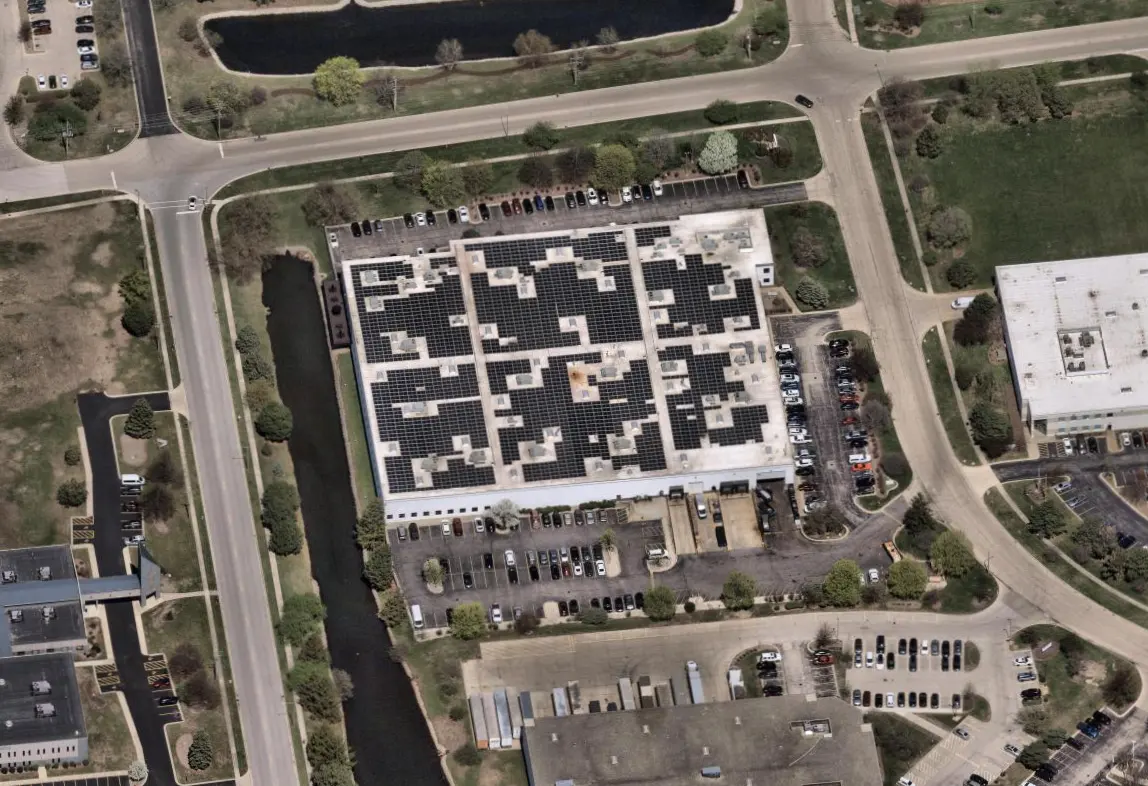
General educational information, not project-specific tax, legal or engineering advice. Eligibility and savings depend on the project, taxpayer, tariffs and contracts. Example calculations are hypothetical and are not a forecast. Prepared for Drew Mays’s GEC byline with AI-assisted research, drafting and source checks dated October 21, 2026. Rooftop photograph is from GEC’s existing website asset library and is not the facility in the hypothetical example.