Updated October 9, 2026: rebate-linked dispatch duties, current and proposed rate-product terms, and standalone application timing. Financial examples use the source dates stated below. Confirm current rates before making a project decision.
PJM capacity prices have cleared at the FERC-approved cap in each of the last two auctions, and that cost reaches Illinois commercial bills through a charge most facility teams have never itemized. A battery sized against that reality either attacks real money or it quietly loses it, and the difference is the facility's own load shape. This guide works through the actual math.
Fast Facts
- The three charges that matter: Energy ($/kWh), the Distribution Facilities Charge or DFC ($/kW of billing demand), and PJM capacity, the charge tied to five hours ComEd and PJM will not tell you about in advance.
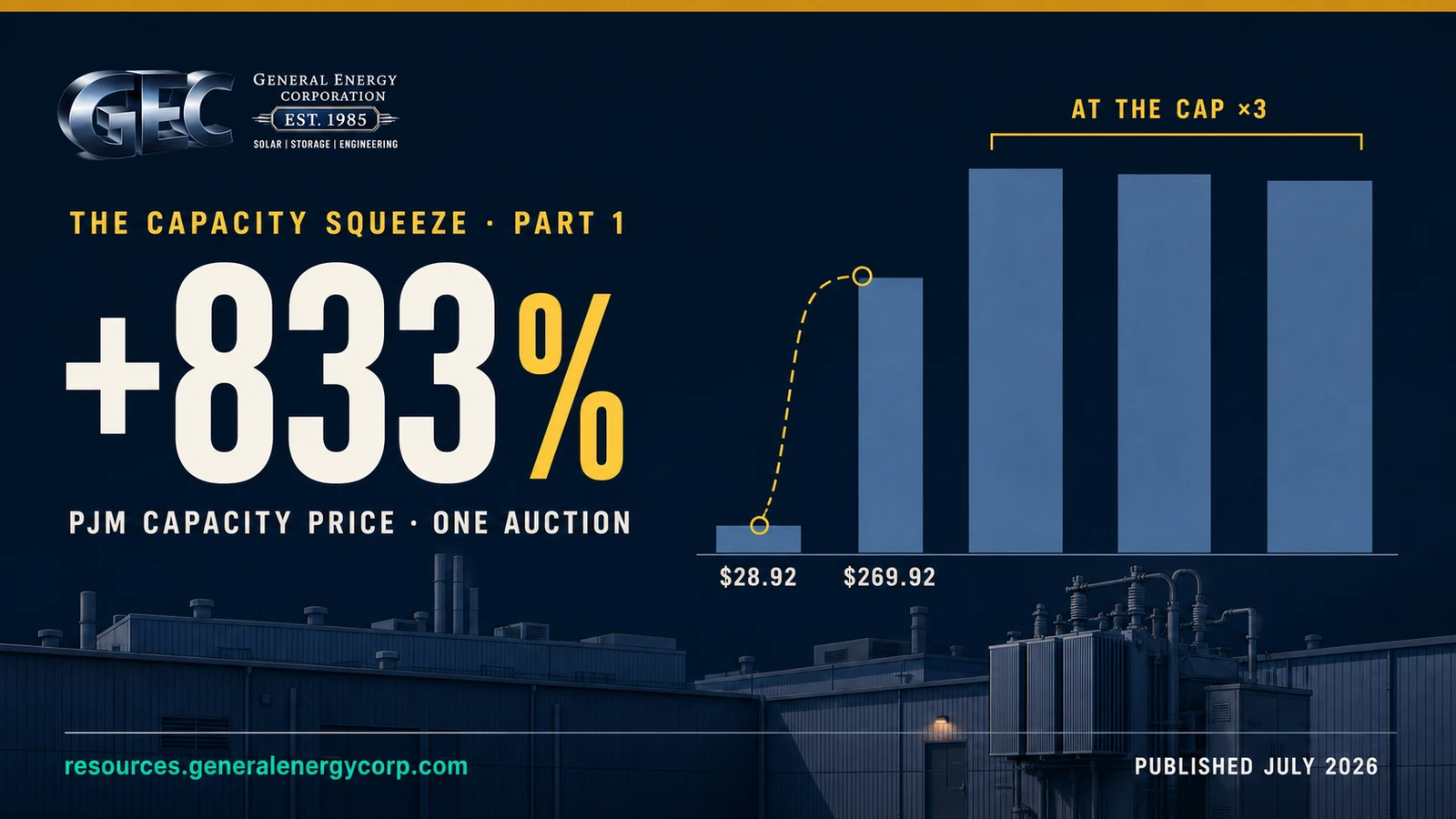
- Current PJM capacity price, ComEd zone: $329.17 per MW-day for the 2026/27 Delivery Year, in effect now, rising to $333.44 per MW-day for 2027/28. Both cleared at the FERC-approved price cap.
- The storage rebate: The commercial equipment-rebate example uses $250 per kWh of eligible capacity. Rebate-linked storage can require summer SDVPP participation. ComEd’s future-dated standalone provisions describe application intake no earlier than January 1, 2027, subject to effective terms and actual availability.
- The one-sentence verdict: A battery's payback is decided by the facility's load shape, not by the sales pitch. A peaky, multi-shift load with a real gap between average and maximum demand can capture real money. A flat, continuous load mostly cannot.
- Primary sources: ComEd's nonresidential rate summary (comed.com), PJM's 2027/2028 Base Residual Auction report (pjm.com), the Illinois Commerce Commission's Plug In Illinois page, ComEd's Rider DG Rebate terms, and NREL's 2024 Annual Technology Baseline.
- 1 A battery can directly reduce two of the three charges on a ComEd bill: the Distribution Facilities Charge (by shaving the facility's own monthly peak) and the PJM capacity tag (by reducing load during five specific summer hours). It cannot touch the energy rate itself except through arbitrage under hourly pricing.
- 2 The DFC runs $10.10 to $12.84 per kW for the Large Load delivery class (400 to 1,000 kW), depending on primary or secondary voltage service. The capacity tag is worth far more per kW, currently $329.17 per MW-day, but it is set by five hours PJM only publishes after the fact.
- 3 A representative 500 kW facility pairing a 350 kW, 700 kWh battery against both charges can see real annual value, shown as a ledger of separate line items in the worked example below, never blended into one number.
- 4 Round-trip losses run about 15 percent on every cycle, and missing even one of the five PJM peak hours forfeits that hour's contribution to next year's capacity tag. A flat, low-variability load has little demand-charge shave to capture in the first place. Those are the honest limits.
The four-click read
Four things to know before sizing a battery against a ComEd bill
The whole guide in four cards. Each links to the section that proves it.
What you pay for
Energy, the Distribution Facilities Charge, and PJM capacity are three separate charges with three separate mechanisms. Most facility teams have never separated them on their own bill.
Read the billWhat a battery can cut
A battery attacks the DFC and the capacity tag directly. Arbitrage and the DG Rebate are the other two value streams, each with its own honest constraint.
The four value streamsThe worked example
A representative 500 kW facility, a 350 kW / 700 kWh battery, and the actual dollar math across a base case, a downside case, and an upside case.
See the numbersWhen it fails
Flat load profiles, low load factor, small peaks, and missed dispatch windows all cut into the math. This section is written straight, on purpose.
The honest limitsRead your ComEd bill before you size anything
ComEd separates every nonresidential bill into Delivery Services, the wires and infrastructure charges ComEd itself controls, and Electricity Supply Services, the energy and PJM-related charges tied to whatever supply arrangement the customer has chosen. Delivery includes the Distribution Facilities Charge, the customer charge, and the metering charge. Supply includes the energy rate and, for most commercial accounts, a capacity charge that rides on top of it. ComEd-supplied accounts with at least 100 kW of load generally receive hourly-varying supply prices under Rate BESH, while a competitive supply contract or an eligible fixed-price tariff can set different terms, which is the detail that determines whether energy arbitrage is even available. (comed.com, nonresidential line item summary)
- Energy ($/kWh): The price per kilowatt-hour actually consumed. ComEd's own summer 2026 Price to Compare, the default supply benchmark, is 10.399 cents per kWh (8.677 cents supply plus 1.722 cents transmission), effective June 1 through September 30, 2026. That figure is the fixed-price comparison benchmark, not the assumed supply rate for a large interval-billed account. (Plug In Illinois, ICC)
- Billing demand ($/kW), the DFC: A charge on the highest 30-minute demand recorded in the monthly billing period, at a rate that varies by delivery class and voltage level. For the main commercial classes it runs roughly $11 to $13 per kW at secondary voltage and $5.75 to $10.25 per kW at primary voltage. This is the charge a battery targets first.
- Capacity ($/kW-month or $/MW-day): A separate charge tied to the customer's share of PJM's five annual system peak hours, priced off the ComEd zone's cleared capacity price for the delivery year. It rides on the supply side of the bill: hourly-pricing customers see it as its own capacity line, while fixed-price and many competitive-supply customers pay it inside the supply charge. It is also climbing: the ComEd zone cleared at the FERC-approved price cap in each of the last two capacity auctions.
How your demand charge is actually set
ComEd measures billing demand as the Maximum Kilowatts Delivered, or MKD: the single highest 30-minute demand interval recorded anywhere in the monthly billing period, with many delivery classes measured within a weekday daytime window, a detail GEC confirms from the account's own tariff terms. One bad half hour sets the whole month's DFC charge, which is exactly what makes a battery's job simple in concept: shave that one interval and the charge drops for the entire month. Billing demand resets each period per the tariff's measured-demand definition. GEC confirms the specifics for your delivery class during the engineering screen, since some utilities apply a ratchet that carries a prior peak forward and ComEd's own published materials are the source of record for whether and how that applies to your account.
ComEd Distribution Facilities Charge (DFC) by delivery class, $/kW of MKD (resultant billed charges beginning with the January 2026 bill, per ComEd's delivery-charge guide)
| Delivery class | Secondary voltage | Primary voltage |
|---|---|---|
| Small Load (0 to 100 kW) | $12.85 | $5.77 |
| Medium Load (over 100 to 400 kW) | $12.94 | $7.34 |
| Large Load (over 400 to 1,000 kW) | $12.84 | $10.10 |
| Very Large Load (over 1,000 to 10,000 kW) | $12.34 | $10.04 |
| Extra Large Load (over 10,000 kW) | $10.91 | $10.17 |
High Voltage delivery (69 kV and above) uses a different charge structure, with separate high-voltage facilities and transformer charges, so it is not shown in this table.
This is the DFC table read directly from ComEd's own delivery-charge guide, the latest version ComEd publishes as of this writing. These are the resultant billed charges beginning with the January 2026 bill. Delivery rates move through Illinois Commerce Commission proceedings, so GEC pulls the facility's current class rate from the live tariff during every engineering screen. The table is also the reason a single flat number is always wrong. A facility in the Large Load class, 400 to 1,000 kW of demand, the class most commercial and light-industrial accounts fall into, pays $10.10 per kW at primary voltage service or $12.84 per kW at secondary voltage, a real spread depending on how the facility is served. A representative Large Load facility at 500 kW of billing demand, served at secondary voltage and doing nothing to manage its peak, pays roughly 500 kW times $12.84, or about $6,420 in DFC charges that month, before demand response of any kind. (comed.com, delivery-charge guide, January 2026)
The capacity tag: the charge you set in five afternoons
PJM identifies the five highest non-holiday weekday hourly system peaks between June 1 and September 30 each year, the '5 Coincident Peaks' or 5CP. A customer's average demand across those five specific hours becomes its Peak Load Contribution, or PLC, the 'capacity tag' that sets that customer's share of PJM capacity cost for the delivery year beginning the following June 1. PJM identifies the five hours after the summer ends, generally publishing them in the fall, months after the fact, which means no one dispatches a battery against a known schedule. They dispatch against a forecast, and a wrong forecast forfeits that hour's contribution entirely. (PJM, PLC and NSPL education presentation)
One layer of precision matters here. For a ComEd account the final capacity obligation is computed under the governing tariff attachment, which uses the customer's load across the five PJM system peaks plus ComEd's own five zone peaks, applies loss adjustments, and scales the result across the zone. A battery's reduction during the five PJM hours is the main input, not automatically a one-for-one cut in the final tag. GEC models the full calculation during the engineering screen.
The price behind that tag is at the ceiling. PJM's capacity clearing price for the ComEd zone (part of 'Rest of RTO,' with no locational adder) is $329.17 per MW-day for the 2026/27 Delivery Year, in effect now through May 2027, cleared at the FERC-approved price cap. The 2027/28 Delivery Year cleared at $333.44 per MW-day, again at the cap, in an auction PJM's own no-cap simulation suggests would have cleared closer to $529.80 per MW-day without the collar. (PJM, 2027/2028 Base Residual Auction report and Illinois Power Agency, energy storage procurement)
What a Peak Load Contribution (PLC) reduction is worth, ComEd zone (gross clearing-price equivalent, before ComEd's PLC adjustments and supplier billing treatment)
| PLC reduction | Annual value, 2026/27 ($329.17/MW-day) | Annual value, 2027/28 ($333.44/MW-day) |
|---|---|---|
| 100 kW | $12,015 | $12,171 |
| 250 kW | $30,037 | $30,426 |
| 500 kW | $60,074 | $60,853 |
That table is arithmetic on the published clearing price (kW reduced, converted to MW, times the daily price, times 365 days), not a modeled estimate. It is also why the capacity tag is the highest-dollar-per-kW stream a battery can chase, and the least predictable. Get the five hours right and the value in that table is the gross ceiling. Miss one, and in this simplified arithmetic the average across the remaining four hours falls short of it.
What a battery can and cannot do about each charge
Four separate value streams exist for a C&I battery in ComEd territory, and they should never be blended into one number. Each has its own mechanism, its own predictability, and its own honest constraint.
The four battery value streams in ComEd territory
| Value stream | Mechanism | Honest constraint |
|---|---|---|
| Billing demand (DFC) reduction | Shave the highest 30-minute MKD in the monthly billing period at the applicable $/kW rate. | The most controllable and predictable stream. It only requires shaving the facility's own peak, not a system-wide event. |
| Capacity tag (PLC) reduction | Reduce load during the five actual PJM coincident-peak hours, lowering next year's capacity cost. | The highest dollar-per-kW stream, and the least predictable. The five hours are unknown until after the summer ends, when PJM publishes them in the fall, and missing even one forfeits its contribution. |
| Energy arbitrage | Charge during low-price hours and discharge during high-price hours under hourly pricing (Rate BESH or Rider PPO). | Value depends entirely on the daily price spread the facility actually sees, and PJM caps the real-time hourly energy price at $3.70 per kWh as an outer bound, not a typical spread. Every cycle also loses roughly 15 percent to round-trip inefficiency. |
| DG Rebate and demand-response programs | An illustrative $250 per kWh equipment rebate in the qualifying commercial category. ComEd’s September 4 advance copy describes standalone-storage applications no earlier than January 1, 2027. As of October 9, effective terms and actual intake must still be confirmed. Other program payments depend on their own terms. | Confirm the account category, application history, payable capacity and dispatch obligations before forecasting a rebate. Eligible storage whose rebate was submitted and subsequently received on or after June 1, 2026 must participate in SDVPP. Same-hour paid grid services can reduce the SDVPP performance credited by ComEd. |
The worked example: a 500 kW manufacturer
This is a representative example built to show the mechanics, not a documented facility. No primary source gives a single 'typical' Illinois manufacturing load profile, so every number below is illustrative, clearly labeled, and built from the rates and prices sourced above rather than invented savings claims.
The facility: a 500 kW peak, Large Load delivery class, secondary voltage service. The battery: 350 kW of power and 700 kWh of energy, a 2-hour duration system sized to sustain a meaningful shave through a full 30-minute billing interval or a full PJM coincident-peak hour with room to spare. At 85 percent, the representative round-trip efficiency in NREL's 2024 Annual Technology Baseline, replenishing a full 700 kWh discharge requires drawing roughly 824 kWh from the grid (700 divided by 0.85), the loss every dispatch carries. (NREL, 2024 Annual Technology Baseline)
Representative monthly billing peak, with and without the battery (illustrative, not measured data)
| Month | Peak without battery | Peak with battery (250 kW base-case shave) |
|---|---|---|
| January | 465 kW | 215 kW |
| February | 470 kW | 220 kW |
| March | 480 kW | 230 kW |
| April | 485 kW | 235 kW |
| May | 495 kW | 245 kW |
| June | 500 kW | 250 kW |
| July | 500 kW | 250 kW |
| August | 500 kW | 250 kW |
| September | 495 kW | 245 kW |
| October | 480 kW | 230 kW |
| November | 470 kW | 220 kW |
| December | 460 kW | 210 kW |
One summer dispatch day: on a July weekday, the facility's demand climbs toward its 500 kW peak in the early afternoon. The battery, already charged overnight during low-price hours, discharges at 250 kW for the 30-minute interval most likely to set the month's MKD, holding the metered peak to 250 kW. If that same afternoon happens to fall inside one of PJM's five coincident-peak hours (only knowable for certain months later), the same 250 kW of held-back demand also reduces the facility's contribution to next year's capacity tag. One dispatch, two value streams, if the timing lines up.
- Base case, DFC reduction: A 250 kW monthly shave at the Large Load class rate runs $2,525.00 per month at primary voltage ($10.10/kW) to $3,210.00 per month at secondary voltage ($12.84/kW), or roughly $30,300 to $38,520 per year if sustained across all 12 billing periods.
- Base case, capacity-tag reduction: A 250 kW PLC reduction, if the battery discharges through all five PJM coincident-peak hours, is worth $30,037 per year at the 2026/27 clearing price of $329.17 per MW-day (rising toward $30,426 at the 2027/28 price of $333.44 per MW-day).
- Downside case, missed one 5CP afternoon: In the simplified five-hour arithmetic, if the battery misses one of the five hours (a wrong forecast, a prior discharge that left it empty), the average reduction across the remaining four hours falls to 200 kW, and the capacity-tag value drops to roughly $24,029 per year at the 2026/27 price, a difference of about $6,000 for missing a single afternoon.
- Energy arbitrage: Not modeled with a single figure here. PJM caps the real-time hourly energy price at $3.70 per kWh, the outer bound on any single spread, not a typical one. Realized arbitrage value depends on the facility's actual daily price volatility under Rate BESH or Rider PPO and the roughly 15 percent round-trip loss on every cycle. GEC models this stream against the facility's real interval and hourly-price data, not a representative number.
- Rider DG Rebate, one-time: At an assumed $250 per kWh commercial rate, 700 kWh of fully eligible capacity corresponds to an illustrative $175,000 equipment rebate before limits, costs and taxes. It is not an award or eligibility decision. Confirm the account category, payable capacity and rebate-linked dispatch duties.
- Upside case: All five 5CP hours captured and the DFC shave held every month at the secondary-voltage rate: roughly $38,520 a year in DFC savings, $30,037 a year in capacity-tag value, and a separate $175,000 one-time rebate check in year one, tracked as three distinct lines, not a combined figure. Arbitrage and any demand-response enrollment sit outside this tally entirely.
Every figure above is a representative example built on sourced rates, not a projection for any real facility. GEC runs this same math against a facility's actual 12 months of ComEd bills and interval data during the engineering screen, which is the only way to know whether a specific load shape produces this kind of result.
Solar-only, battery-only, or both
The right combination follows the facility's load shape, not a default. Solar offsets energy consumption during daylight hours and does nothing for a demand charge unless the facility's peak happens to land when the sun is producing, or unless it is paired with storage. A battery targets the DFC and the capacity tag directly, on its own schedule, regardless of what the sun is doing.
- Single-shift, daytime-only operation: Peak demand tends to land during production hours, which is also when solar is producing. Solar alone captures real energy savings here, and a battery adds demand-charge and capacity-tag value on top.
- Two-shift operation: Peaks extend into the evening, past solar's production window. A battery becomes the primary lever for the DFC and capacity charges, charged from solar or the grid during the cheaper hours and discharged against the facility's actual peak.
- Continuous, 24-7 operation: A flat, high-load-factor profile has a smaller gap between average and maximum demand, which means less peak for a battery to shave in the first place. This is exactly the profile covered in the honest-limits section below.
When a battery will not pay back
This section exists because the honest answer sometimes is no. A battery's economics depend entirely on the gap between a facility's average demand and its maximum demand, and on how reliably that gap can be captured.
- Flat, low-variability load profiles: A facility that runs close to the same demand around the clock has little peak to shave. If the highest 30-minute interval is barely above the average, a battery has almost nothing to cut against the DFC.
- Low load factor claims cut both ways: A low load factor (a big gap between average and peak demand) is actually the profile that favors a battery, since there is real peak to shave. A high load factor, close to continuous full-load operation, is the profile where the math gets hard.
- Missed dispatch on the 5CP hours: Because PJM's five coincident-peak hours are unknown in advance and only published after the summer ends, generally in the fall, a battery dispatched on the wrong hours captures none of the capacity-tag value for that year, no matter how well it performed on every other hour.
- Round-trip losses are real, every cycle: 85 percent is the representative round-trip efficiency in NREL's 2024 Annual Technology Baseline. Every kWh discharged costs roughly 1.18 kWh charged. That loss has to be smaller than the value captured, or the stream is a net cost.
- Standalone timing and rebate-linked dispatch duties: ComEd’s September 4 advance copy, listed for October 19, 2026, describes standalone storage and says applications will not be accepted until January 1, 2027. It is future-dated and for information only as of October 9. Confirm the effective tariff, actual intake and project eligibility with ComEd. Eligible rebate-linked storage must also meet its SDVPP term and operating duties.
None of this is a reason to skip the analysis. It is a reason to run the actual numbers before committing capital, which is what the engineering screen at the end of this guide is for.
The incentive layer
A battery’s investment case needs separate lines for any eligible equipment rebate, bill savings and tax incentives. The illustrative commercial rebate here uses $250 per kWh of eligible capacity, subject to limits and approval. Federal credit and depreciation assumptions require project-specific tax review, including location, labor and separate solar and storage timing. See GEC’s ComEd battery storage rebate guide, Energy Community bonus guide and Incentives pillar.
Rider SDVPP, effective July 16, 2026, requires participation for eligible storage whose DG Rebate was submitted and subsequently received on or after June 1, 2026. The program term is five years. A participant starting during a season completes that remaining season and four subsequent seasons, subject to the tariff’s transition provisions. ComEd must make service available no later than March 1, 2027. That is a program availability date, not a purchase deadline. Read GEC’s ComEd battery rebate dispatch rules before committing output for savings or backup.
Under the DG Rebate tariff in force on October 9, 2026, Resource 2B storage-rebate recipients, including residential and eligible small-business accounts, must remain on a ComEd Qualifying Utility Product for the battery’s life. A QUP can use time-varying supply or delivery pricing. ComEd’s September 4 proposed revision, listed for an October 19 effective date, omits those QUP provisions. Before choosing a rate, confirm the effective tariff and any existing project obligations with ComEd. Do not copy this customer-category rule to every larger commercial account.
ComEd’s September 4 advance rebate tariff carries an October 19, 2026 effective date and says standalone-storage applications will not be accepted until January 1, 2027. The copy is for information only. It describes batteries interconnected after June 1, 2026, without renewable-generation pairing, that charge solely from the grid. Confirm the final effective tariff, application intake and project-specific limits with ComEd before counting a rebate.
SDVPP compensation is $10 per kW-season of qualifying seasonal average output, rather than battery nameplate kW. Sheet 475 permits a reduction when another program pays for grid services in the same dispatch-window hours. These duties must be included in one operating model before combining projected payments or savings. Source: ComEd Rider SDVPP.
ComEd charges the Distribution Facilities Charge on the Maximum Kilowatts Delivered, the highest 30-minute demand interval recorded during the monthly billing period. The rate ranges from roughly $5.75 to $13 per kW depending on delivery class and voltage service. A Large Load facility (400 to 1,000 kW) pays $12.84 per kW at secondary voltage or $10.10 at primary, per ComEd's January 2026 delivery-charge guide.
Yes. A battery sized to discharge during the facility's own highest 30-minute demand interval each month directly lowers the Maximum Kilowatts Delivered that sets the Distribution Facilities Charge. This is the most predictable of the battery value streams because it only requires managing the facility's own peak, not a system-wide event.
A capacity tag, or Peak Load Contribution, is a customer's average demand during the five highest system-wide peak hours PJM identifies each summer. That figure sets the customer's share of PJM capacity cost for the following delivery year. The five hours are only published after the summer ends, generally in the fall, which makes the tag the highest-value and least predictable battery target.
Sizing depends on how much of the peak needs to be shaved and for how long. A battery rated for the target kW reduction with enough kWh to sustain it through a full 30-minute billing interval, or a full hour for capacity-tag events, with margin for round-trip losses, is the starting point GEC works from during the engineering screen using the facility's actual interval data.
Solar pairing is not what establishes bill savings. A battery’s schedule must fit the tariff, supply contract, load and reserve requirements. For the rebate, ComEd’s September 4 advance copy describes standalone applications no earlier than January 1, 2027. Confirm effective terms and actual intake before counting a storage-only rebate.
This guide’s illustrative commercial equipment-rebate rate is $250 per kWh of eligible nameplate capacity, subject to account category, payable-capacity limits and approval. Eligible rebate-linked storage also has SDVPP duties. The future-dated standalone copy describes applications no earlier than January 1, 2027. Confirm effective terms and actual intake.
When the facility runs a flat, continuous load with little gap between average and maximum demand, there is not much peak for a battery to shave. Round-trip losses of roughly 15 percent also mean the value captured has to clear that loss before a battery pencils out, which is why the actual load shape, not a rule of thumb, decides the answer.
This guide is general information, not tax, legal, or engineering advice. The worked example in this guide (the 500 kW facility, its load profile, and its dollar figures) is a representative example built to illustrate the mechanics, not a projection for any specific facility. ComEd tariff rates, PJM capacity prices, and rebate terms are governed by the documents in effect at the relevant time and can change. The rebate and dispatch rules were checked October 9, 2026. The other rate and capacity-price examples use July 16, 2026 sources. Confirm current rates, eligibility, and tax treatment with ComEd, PJM, your tax advisor, and the primary sources linked here before acting.
Find Out What Your Load Shape Is Worth
Send your last 12 ComEd bills and an interval-data export. GEC returns an engineering screen of your actual demand-charge and capacity-tag savings potential, sized to your real load shape, not a representative example. No commitment to build.