The Belden Brick Company has been making brick in Sugarcreek, Ohio for 141 years, five generations of the same family. In 2025, the capacity charge on its electric bill went from about $1,600 a month to about $12,000 a month, as Reuters reported in July.
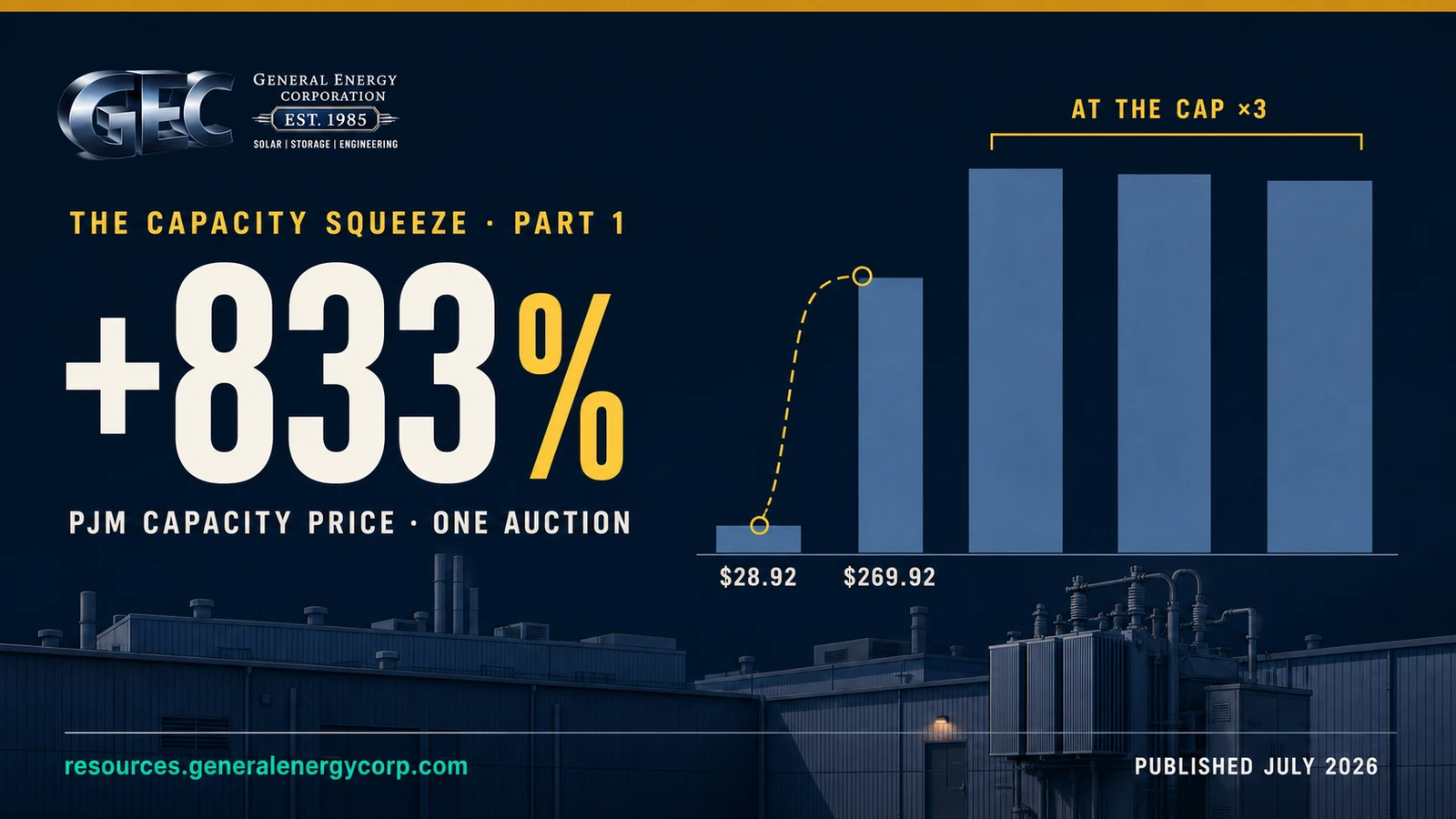
PJM's capacity price went from $28.92 per megawatt-day for the 2024/25 delivery year to $269.92 for 2025/26, an 833 percent increase in a single auction. Every auction since has cleared at the price cap, most recently $325 for 2028/29, announced July 14, 2026.
Nothing changed inside that plant. What changed was a single number set at an annual auction most manufacturers have never heard of: the price PJM Interconnection pays generators to guarantee power will be there at peak demand. That number rose 833 percent in one year, and it has not come back down. This article is the full story, told for the people who pay for it.
- 1 PJM's capacity market price rose from $28.92 to $269.92 per megawatt-day at the 2024 auction, then cleared at the regulatory cap in all three auctions since. The 2028/29 auction cleared at $325 and still came up 6,831 MW short of the reliability requirement.
- 2 The squeeze is demand meeting stalled supply. Monitoring Analytics attributes $6.3 billion of the $16.4 billion in 2028/29 auction charges, about 38 percent, to data center load. Meanwhile only 525 MW of genuinely new generation cleared.
- 3 This is landing on real factories. Belden Brick in Ohio saw its monthly capacity charge go from $1,600 to $12,000. Plaskolite's charges across Pennsylvania and Ohio went from $200,000 to $1.2 million a year, per Reuters.
- 4 Northern Illinois currently pays the system price with no zonal premium. But PJM's own math says the last auction would have cleared near $555 without the cap, and $777 in the ComEd zone. The cap is doing more work for Illinois than almost anywhere else.
What Happened to PJM Capacity Prices?
PJM's capacity price rose from $28.92 per megawatt-day for the 2024/25 delivery year to $269.92 for 2025/26, an 833 percent increase in a single auction. The three auctions since have all cleared at the price cap: $329.17 for 2026/27, $333.44 for 2027/28, and $325.00 for 2028/29.
PJM system-wide capacity clearing price by delivery year, from PJM Base Residual Auction results and Monitoring Analytics reports. Reserve margin is the cushion between available supply and expected peak demand.
| Delivery year | Clearing price ($/MW-day) | What happened |
|---|---|---|
| 2021/22 | $140.00 | |
| 2022/23 | $50.00 | |
| 2023/24 | $34.13 | Reserve margin 21.6% |
| 2024/25 | $28.92 | Reserve margin 21.7%. Total cost about $2.2B |
| 2025/26 | $269.92 | Up 833% in one auction. Total cost about $14.7B. Margin 18.6% |
| 2026/27 | $329.17 | First auction under the price collar. Total cost about $16.1B |
| 2027/28 | $333.44 | Cleared at the cap. First shortfall against the reliability requirement |
| 2028/29 | $325.00 | Cleared at the cap again. 6,831 MW short. Total cost about $16.4B |
The most recent result came on July 14, 2026, when PJM announced that its 2028/29 Base Residual Auction procured 138,318 MW of capacity at $325 per megawatt-day, the ceiling set in coordination with the governors of all 13 PJM states and the Federal Energy Regulatory Commission. The price is technically a 2.5 percent decrease from the prior year. That is not relief. It is the sound of an auction pressing against its lid for the third consecutive time.
What Is a Capacity Charge, and Why Does Your Facility Pay It?
A capacity charge is the price of guaranteed availability. PJM, the regional transmission organization (RTO) that operates the grid for 13 states and Washington D.C., runs an annual auction that pays generators to promise their output will be available during the highest-demand hours of a future delivery year. Utilities and competitive suppliers pass that cost through to every customer, and commercial accounts pay it through capacity-related supply charges tied to their peak usage.
The reason manufacturers feel it more than almost anyone: exposure scales with how much power you draw and when you draw it. Electricity runs roughly 10 percent of a typical residential bill but up to three times that share of costs for a manufacturer, according to Reuters. On a demand-metered industrial account, the capacity obligation is set largely by the facility's draw during a handful of the grid's highest-demand hours of the prior summer. A plant running full shifts through a July afternoon is buying capacity at whatever the auction cleared, whether or not anyone in the building has ever read a PJM auction report.
We covered how these charges flow into northern Illinois bills specifically in our piece on rising Illinois commercial electricity costs. This article is about the machine behind those line items.
Why Did the Price Jump 833 Percent in One Auction?
Because demand started growing again just as supply stopped keeping up. Data center construction and broader electrification pushed PJM's load forecast upward while older plants retired faster than new generation came online. The reserve margin, the cushion between available supply and expected peak, fell from 21.7 percent to 18.6 percent in one year, and a tighter market priced accordingly.
For two decades PJM had more generation than it needed, and capacity was cheap. A manufacturer could ignore it because it rounded to noise. That surplus is gone. By the 2027/28 auction the reserve margin had fallen to 14.4 percent, and the auction failed to procure enough capacity to meet PJM's reliability requirement for the first time. The 2028/29 auction missed the requirement again, by 6,831 MW, even with every price signal in the market screaming for new supply.
The demand side of the squeeze has a name. Monitoring Analytics, PJM's independent market monitor, attributes $6.3 billion of the $16.4 billion in 2028/29 auction charges, about 38 percent, to data center load. Across the last four auctions, the monitor puts data-center-related capacity charges at nearly half of the $63.6 billion in total charges. Who ends up paying for that growth is a big enough question that it gets its own article in this series.
The supply side is the quieter half of the story, and the more stubborn one. Of the 138,318 MW that cleared the 2028/29 auction, only 525 MW was new generation and uprates. Everything else was existing supply repricing at the cap. New plants face multi-year interconnection queues and long equipment lead times, which means the shortage cannot fix itself quickly no matter what the price does.
What Does This Look Like Inside a Real Plant?
Belden Brick's monthly capacity charge went from about $1,600 to about $12,000. Plaskolite, a plastics manufacturer with Pennsylvania and Ohio facilities, saw capacity charges across its plants go from roughly $200,000 to $1.2 million a year. Both are documented in Reuters' July 2026 report on Rust Belt factories and data center growth, where company president Brad Belden said the charge "just jumped off the page."
Those are not businesses that made a bad energy decision. They are businesses that stood still while one line item on the bill multiplied by seven. Capacity is uniquely frustrating that way. You cannot negotiate it away, because every competitive supplier embeds the same auction price in its offers. The charge simply arrives, sized to your facility's peak draw, priced at an auction you had no seat at.
The physical grid behind the prices is telling the same story. During the late-June 2026 heat wave, PJM took emergency steps, including asking users to curb consumption, to avoid rolling blackouts as peak demand hit a record, per Reuters. High capacity prices are what scarcity looks like on a bill. A record peak with emergency conservation calls is what it looks like on the ground.
Does Northern Illinois Pay More Than the Rest of PJM?
Not currently, and that surprises people. In the 2025/26 auction the ComEd zone cleared at the system-wide price of $269.92 with no zonal premium, while the BGE zone in Maryland cleared at $466.35 and Dominion in Virginia at $444.26. Northern Illinois has been paying the system price, not a markup.
The forward-looking number is less comfortable. PJM's own simulated auction results show that without the price collar, the 2028/29 market would have cleared at $554.72 per megawatt-day across the footprint, and near $777 in the ComEd zone. Total charges would have been $29.7 billion instead of $16.4 billion. Read that pairing carefully: the zone with the most cap-suppressed price pressure in the entire footprint is the one covering northern Illinois manufacturing. The collar, which is the price cap paired with a matching price floor, was approved by FERC for four auctions in total, the original two plus an extension covering 2028/29 and 2029/30. The December 2026 auction for 2029/2030 is the last of the four, and what replaces the collar after that is an open regulatory question.
The cap is currently absorbing more price pressure for the ComEd zone than for any other part of PJM, based on PJM's own uncapped sensitivity. An Illinois manufacturer's capacity cost today reflects the collar, not the underlying scarcity. Planning against today's bill means planning against a number that regulation, not the market, is holding down.
What Happens Between Now and December?
Three things are in motion. PJM files its backstop proposals with federal regulators in July. A special backstop procurement is planned for September to bring additional resources forward. And commitments from that process are set to be finalized before the December 9 auction for the 2029/2030 delivery year.
The backstop is worth watching for who is driving it. The winning proposal in PJM's stakeholder process was led by the Data Center Coalition and electric utilities including Exelon, ComEd's parent. In plain terms, the interests that represent the new demand are co-authoring the mechanism for procuring the supply to serve it. Whether that produces a fair split of costs is exactly the question regulators are starting to circle.
Washington is already moving. On June 18, 2026, FERC ordered all six regional grid operators to justify or reform how they connect very large new loads, with answers due in 60 days. The orders explicitly name manufacturing facilities alongside data centers among the loads at issue (dockets EL26-67 through EL26-72). If your company is planning an expansion or a new facility, the rules for getting it connected to the grid are being rewritten right now. Who ends up paying for whose growth is the subject of the next article in this series.
What Can a Manufacturer Actually Control?
You cannot control the auction. You can control the load the auction bills you for. A facility's capacity obligation is set by its draw during the grid's peak hours, which means peak-hour management, demand response participation, and on-site generation paired with storage all shrink the number the market multiplies by whatever price clears. Those levers, with honest tradeoffs, are the final article in this series.
For the mechanics of how batteries specifically attack demand and capacity charges on a ComEd account, our demand-charge and battery payback analysis walks the math. The short version is that the fastest-growing line on the bill is also the one behind-the-meter assets are built to reduce, and the economics improved every time an auction cleared at the cap.
This is Part 1 of a five-part series on what PJM's capacity market is doing to manufacturing costs. Coming next: who is paying for data center growth, what the September backstop auction is and what happens if it falls short, how the same PJM price lands differently in Illinois, Pennsylvania, New Jersey, and Ohio, and the levers a manufacturer can pull. New installments publish in the Illinois Energy Market library, and GEC posts each release on its LinkedIn page.
Get Part 2 When It Drops
Next in the series: who is paying for data center growth. Leave your work email and each installment lands in your inbox the day it publishes. One email per article, written by the author, nothing else.
Frequently Asked Questions
General market information, not tax, legal, or procurement advice. Auction results, tariff structures, and program rules change, and how capacity costs reach a specific facility depends on its rate class, supplier contract, and utility territory. About this article: the named author wrote and reviewed it, AI tools assisted with research and drafting, and each figure was verified against the primary sources linked in the text before publication.