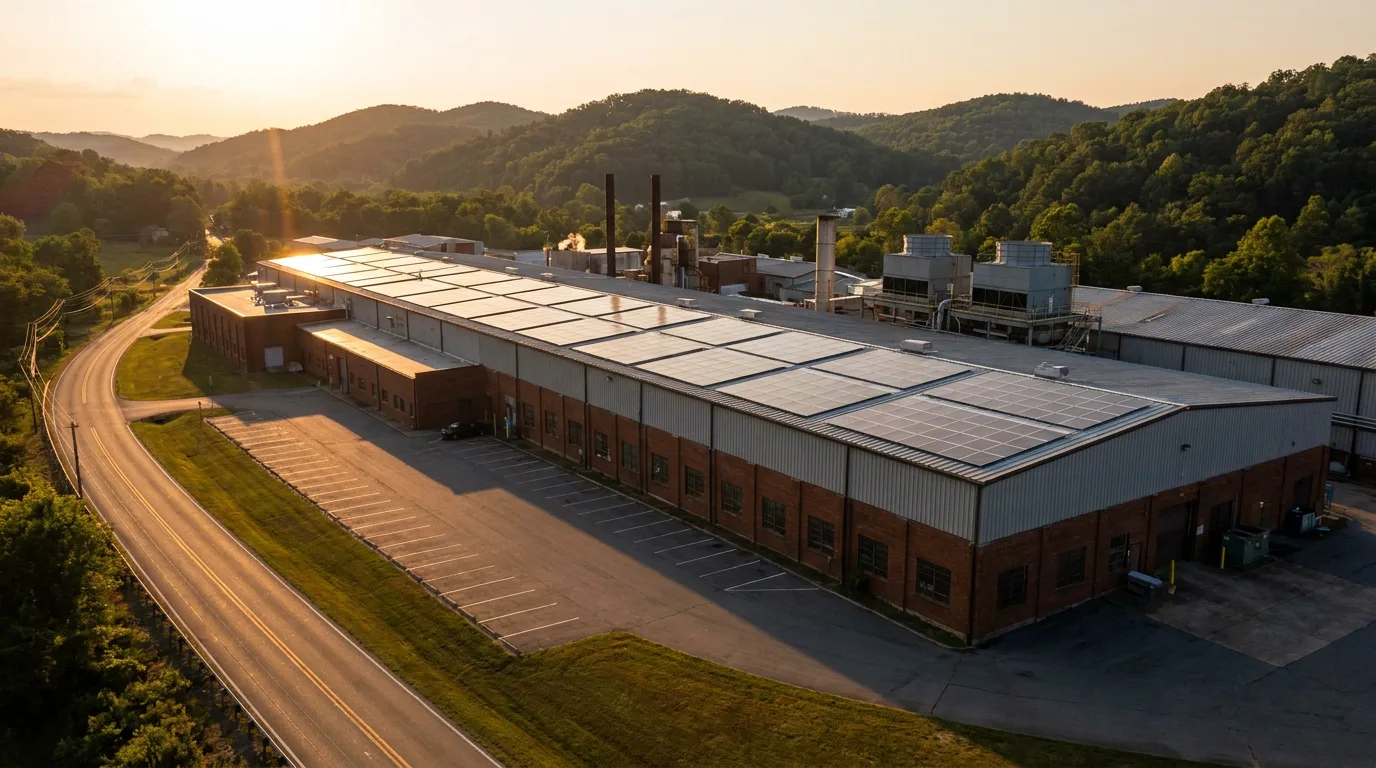
Pennsylvania is running the richest state-level industrial energy grant GEC has seen anywhere it works. RISE PA pays a manufacturer with fewer than 500 employees up to half the cost of an on-site energy project, capped at $500,000, as a grant rather than a tax credit or a loan. Application windows are open now, and the program runs on federal money already awarded to the state.
Fast Facts
- The short version: RISE PA (Reducing Industrial Sector Emissions in Pennsylvania) is a $396 million grant program for Pennsylvania manufacturers. The small-scale track pays 50 percent of total project cost up to $500,000. The medium and large track pays a base grant of 30 percent of total project cost. On-site solar generation is an explicitly eligible project type.
- Who runs it: The Pennsylvania Department of Environmental Protection's Energy Programs Office, funded through the federal Climate Pollution Reduction Grant. PennTAP at Penn State administers the small-scale track. Larger tracks apply through the Commonwealth's eGrants system.
- Who qualifies: Pennsylvania manufacturing facilities, meaning sites that mechanically, physically, or chemically transform materials. The small-scale track is limited to manufacturers with fewer than 500 employees and total project costs between $50,000 and $1,000,000.
- What solar qualifies: On-site renewable generation sized to the facility's own electric load. The portion of a system serving on-site consumption is eligible. Capacity oversized for grid export is not.
- Timing: Small-scale Round 4 is open now and closes in August 2026, with roughly three application cycles per year through 2029. The medium and large track's Round 2 closes July 31, 2026. All funded projects must be complete by April 1, 2029.
- Combines with: The 30 percent federal Section 48E credit, plus a 10 point Energy Community bonus where the project address qualifies. The grant and the credit run on separate rules and are claimed separately.
- Primary sources: PA DEP RISE PA program page. PennTAP RISE PA administrator page. IRS Notice 2025-42 for the federal timeline.
- 1 RISE PA is a grant, not a loan and not a tax credit. For a qualifying small manufacturer, it pays 50 percent of total project cost up to $500,000 on projects between $50,000 and $1,000,000. Larger manufacturers receive a base grant award of 30 percent of total project cost.
- 2 On-site solar is explicitly eligible as renewable generation, with one engineering constraint that matters: the program funds the portion of the system serving the facility's own load, so the system is sized to consumption, not to export.
- 3 The small-scale track requires a free technical assessment first, delivered through PennTAP and its partners. That assessment is the natural first step and costs a manufacturer nothing.
- 4 The federal Section 48E credit runs separately at 30 percent, more where the address qualifies for the Energy Community bonus, and solar projects starting now must be operating by December 31, 2027 to claim it. The grant and the credit are captured individually.
The four-click read
Four things to know about RISE PA
The whole program in four cards. Each links to the section that proves it.
What it pays
Small-scale track: 50 percent of total project cost, up to $500,000, for projects between $50,000 and $1,000,000. Medium and large track: a base grant award of 30 percent of total project cost, paid 90 percent during the project and 10 percent after verification.
What the program paysWho qualifies
Pennsylvania manufacturing facilities. The small-scale track is limited to manufacturers with fewer than 500 employees. The defining test is on-site manufacturing: mechanical, physical, or chemical transformation of materials.
Eligibility in detailSolar's place
On-site renewable generation is an explicitly eligible category. The funded portion is the share of the system serving the facility's own load, which is exactly how a well-engineered commercial system is sized anyway.
How solar fitsThe windows
Small-scale Round 4 closes in August 2026, with roughly three cycles per year through 2029. Medium and large Round 2 closes July 31, 2026. Every funded project completes by April 1, 2029.
Application timingWhat is RISE PA?
RISE PA stands for Reducing Industrial Sector Emissions in Pennsylvania. It is a $396 million grant program run by the Pennsylvania Department of Environmental Protection's Energy Programs Office, funded through the federal Climate Pollution Reduction Grant. The program's purpose is direct: pay Pennsylvania manufacturers to cut the emissions of their facilities, whether through on-site renewable generation, industrial electrification, energy efficiency, low-carbon fuel switching, or process changes.
Two details set RISE PA apart from most energy incentives. First, it is a grant. The money does not sit behind a tax position the way the federal credit does, and it is not a financing product. Second, the dollars are already awarded to the Commonwealth, so the program is not waiting on a future appropriation. The primary source for everything in this guide is the DEP RISE PA program page and the PennTAP administrator page at Penn State.
What does RISE PA pay?
The program runs in tracks by project size. The two that matter for most manufacturers evaluating an on-site energy project:
RISE PA award tracks (per PA DEP and PennTAP, July 2026)
| Small-Scale Track | Medium and Large Track | |
|---|---|---|
| Grant share | 50% of total project cost | 30% of total project cost (base grant award) |
| Dollar cap | $500,000 | Set by the track's solicitation |
| Project size | $50,000 to $1,000,000 total cost | Above the small-scale band |
| Facility test | Manufacturer, fewer than 500 employees | Pennsylvania manufacturing facility |
| Administrator | PennTAP (Penn State), InfoReady portal | DEP, via the Commonwealth eGrants system |
| Payment | Grant reimbursement | 90% during the project, 10% after verification |
The small-scale track is the headline for most mid-market manufacturers: a $700,000 solar project at a qualifying facility can carry a $350,000 grant. The track has a $40 million total allocation across its rounds, and awards are made round by round. On the medium and large track, DEP describes the base grant award as 30 percent of total project cost, with 90 percent reimbursed as the project progresses and the final 10 percent held until post-project verification.
Some summaries of RISE PA circulate a specific dollar ceiling for the medium and large track. DEP's own program materials describe the 30 percent base grant award formula, and GEC has not verified a published dollar cap against the current solicitation. If the large track is your size range, the cap comes from the solicitation document itself, which is exactly the kind of detail GEC confirms during an assessment rather than repeating secondhand.
Who qualifies?
RISE PA is a manufacturing program, and the eligibility test reads like one. The facility must engage in the mechanical, physical, or chemical transformation of materials at the site. A plant that fabricates, processes, or produces qualifies. A building that only warehouses or distributes does not, per the program's eligibility framing.
- Small-scale track: Pennsylvania manufacturers with fewer than 500 employees, with total project costs between $50,000 and $1,000,000.
- Medium and large track: Pennsylvania manufacturing facilities with larger decarbonization projects, applying through the Commonwealth's eGrants system.
- The project itself: Must reduce the facility's emissions through an eligible category: on-site renewable generation, industrial electrification, energy efficiency and process-emissions reduction, low-carbon fuel switching, carbon capture, or fugitive-emissions reduction.
Does commercial solar qualify?
Yes, explicitly. On-site renewable energy generation is one of the program's named eligible categories, and rooftop or ground-mount solar at a manufacturing facility is the most common form it takes. The program language carries one constraint that any manufacturer should read as good engineering rather than a limitation: only the portion of a renewable energy system generating electricity required on-site is eligible for funding. A system sized to the facility's actual load fits the program. A system oversized to sell power back to the grid does not get funded on the export share.
That constraint aligns with how Pennsylvania's net metering rules already reward sizing to consumption. Under 52 Pa. Code Section 75.13, generation used within the billing period is credited at the full retail rate, while excess left at the annual true-up pays out at the lower price-to-compare rate. The grant and the tariff point at the same design: build to your load.
Battery storage is not named as its own eligible category in the RISE PA program descriptions GEC has reviewed, and storage paired with solar is not addressed either way. DEP answers program questions directly at RA-EP-CPRG@pa.gov, with office hours during open application windows. GEC treats storage scope as a confirm-with-DEP item during scoping rather than an assumption in either direction.
When are the application windows?
RISE PA runs on repeating rounds rather than a single deadline. As of July 2026, per DEP and PennTAP: the small-scale track's Round 4 is open and closes in August 2026, with roughly three application cycles per year and the program running through 2029. The medium and large track's Round 2 opened May 15, 2026 and closes July 31, 2026 at 4:59 PM. Funded projects run 6 to 24 months, every project must be complete by April 1, 2029, and eligible expenses reach back to October 1, 2024.
Missing a round is not fatal because another opens within months. What the calendar does punish is starting the paperwork late, because the small-scale track requires a technical assessment before the application and assessments take real calendar time. A manufacturer who wants a specific round starts the assessment a cycle ahead of it.
How do you apply?
- 1 Start with the free assessment (small-scale track). A no-cost technical and site assessment is a prerequisite before applying. PennTAP delivers it with regional partners including Catalyst Connection, Cadmus Group, and the ITAC network. This step is genuinely free and carries no commitment.
- 2 Define the project and its emissions math. The application is built on the project's measured emissions reduction, which for solar means the facility's load data and the system's modeled generation. This is engineering work, and it is the same work a properly scoped solar design requires anyway.
- 3 File in the right portal. Small-scale applications go through PennTAP's InfoReady portal. Medium and large applications go through the Commonwealth's eGrants system.
- 4 Use DEP's open door while the window is open. DEP runs office hours on Wednesday mornings during open application windows and answers program questions at RA-EP-CPRG@pa.gov.
How does RISE PA combine with the federal credit?
Separately. The grant does not touch the credit and the credit does not touch the grant. The federal Section 48E clean electricity investment credit pays 30 percent of qualified cost, and projects at addresses qualifying as an Energy Community earn a further 10 point bonus. Pennsylvania's coal and industrial geography makes that bonus plausible at many sites, and it is verified against the current IRS lists at the specific project address, never assumed. GEC presents the grant, the credit, and any bonus as individual line items with their own rules, because that is how the IRS and DEP treat them.
The federal timeline is the forcing function in 2026. Under IRS Notice 2025-42 and Section 48E(e)(4), a solar project that begins construction now must be placed in service by December 31, 2027 to claim the credit at all. That is roughly an 18 month runway, which comfortably fits a RISE PA project cycle if the assessment starts soon, and gets uncomfortable for a manufacturer who waits until 2027 to begin.
The rest of the Pennsylvania picture, including PPL Electric's production incentive where it applies, the SREC market, net metering mechanics, and the state's sales tax treatment of commercial generation equipment, is laid out with sources on GEC's Pennsylvania commercial solar incentives page.
General information, not tax or legal advice. Grant eligibility, award amounts, and application requirements are set by the program solicitation in effect at the time of filing. Incentive values depend on your facility, your tax position, and program availability. GEC confirms the specifics for your site during the assessment. How this guide was made: written and reviewed by the author named below. We use AI tools for research and production support, and every figure is checked against the primary sources linked here before publish.
Find Out If Your Facility Fits the Current Round
One recent utility bill per meter plus the facility address is enough to start. GEC checks which RISE PA track and window fits your project size, verifies Energy Community status against the current IRS lists, sizes the system to your actual load, and sends back a projection that separates the grant, the credit, and the utility numbers so you can see what each is worth on its own. It does not commit you to anything.