- 1 ComEd’s Scheduled Dispatch Virtual Power Plant program requires participation for eligible storage whose DG Rebate was submitted and subsequently received on or after June 1, 2026. The tariff provides for ComEd to make service available no later than March 1, 2027. This is a program availability date, not a customer purchase deadline.
- 2 For ordinary behind-the-meter participants, the dispatch window is 4 to 6 p.m. Central Prevailing Time, Monday through Friday, June through September. Community-supply projects have a different window.
- 3 The participant identifies the committed output. The tariff sets no minimum commitment. Choose an amount the facility’s battery and backup plan support.
- 4 Dispatch compensation depends on measured seasonal performance. Evaluate it alongside bill savings, charging costs and the energy held for outages.
Does the ComEd battery rebate require summer dispatch?
Yes, for eligible storage whose DG Rebate was submitted and subsequently received on or after June 1, 2026. ComEd’s Scheduled Dispatch Virtual Power Plant program, or SDVPP, requires that group to participate. The participant identifies the committed output. Confirm the project’s rebate history and agreement before assigning an obligation to an existing battery.
The ComEd SDVPP tariff, sheets 471 through 476, effective July 16, 2026, sets the program’s terms. It provides for customers to begin taking service no later than March 1, 2027. This sets the program’s service-availability timing. It does not require every customer to buy, enroll or begin service by that date. Published tariff documents were checked October 9, 2026. Confirm current enrollment procedures with ComEd before relying on a project schedule.
SDVPP terms to carry into a commercial battery proposal
| Term | What to confirm |
|---|---|
| Required participation | Participation is required for an eligible storage facility whose rebate was submitted and subsequently received on or after June 1, 2026. Confirm the application and award history. |
| Ordinary behind-the-meter window | 4 to 6 p.m. Central Prevailing Time, Monday through Friday, during the June 1 through September 30 season. Community-supply projects use 4 to 7 p.m. |
| Committed output | The participant identifies the commitment in the agreement. There is no minimum commitment in the tariff. Equipment rating and committed output are separate numbers. |
| Participation term | A five-year program term. A participant starting during a season completes the remaining season and four subsequent seasons, subject to the tariff’s transition provisions. |
| Operating priority | The SDVPP commitment takes priority over conflicting commitments. Required smart-inverter operation and data access continue through the program term. |
This guide addresses ComEd accounts in northern Illinois. Confirm your utility and account category before applying these terms to a facility.
Start with the meter and rebate records. A battery’s installation date alone does not establish its participation category. Customers with eligible storage that never received a rebate, or whose qualifying rebate history predates June 1, 2026, have an optional participation path under the tariff. Do not assign identical obligations to every existing battery. Participants who are not required to join as a rebate condition have a notice-based exit. Under sheet 476, termination takes effect December 31 of the year they notify ComEd.
Customer class also affects rebate obligations. Under the DG Rebate tariff in force on October 9, 2026, sheets 247 and 248.4, Resource 2B storage-rebate recipients, including residential and eligible small-business accounts, must remain on a ComEd Qualifying Utility Product for the battery’s life. A QUP can use time-varying supply or delivery pricing. ComEd’s September 4 proposed revision, currently listed for an October 19 effective date, omits those QUP provisions. Before choosing a rate, confirm the effective tariff and any existing project obligations with ComEd.
How much battery output should you commit?
Choose the dispatch commitment from usable battery energy, available power, recharge time and the facility’s reserve requirement. ComEd’s tariff does not require a minimum commitment. The useful question is how much output the system supports throughout the scheduled window while preserving the operating priorities approved by your facilities and finance teams.
Ask the proposer to show a demanding operating day. The facility reaches a high load before 4 p.m. The battery has already discharged to manage it. Dispatch still needs energy later in the afternoon. If backup matters, some energy must remain available after both uses. A model built around a fully charged battery at every event misses this conflict.
A battery does not refill between rows in a savings spreadsheet.
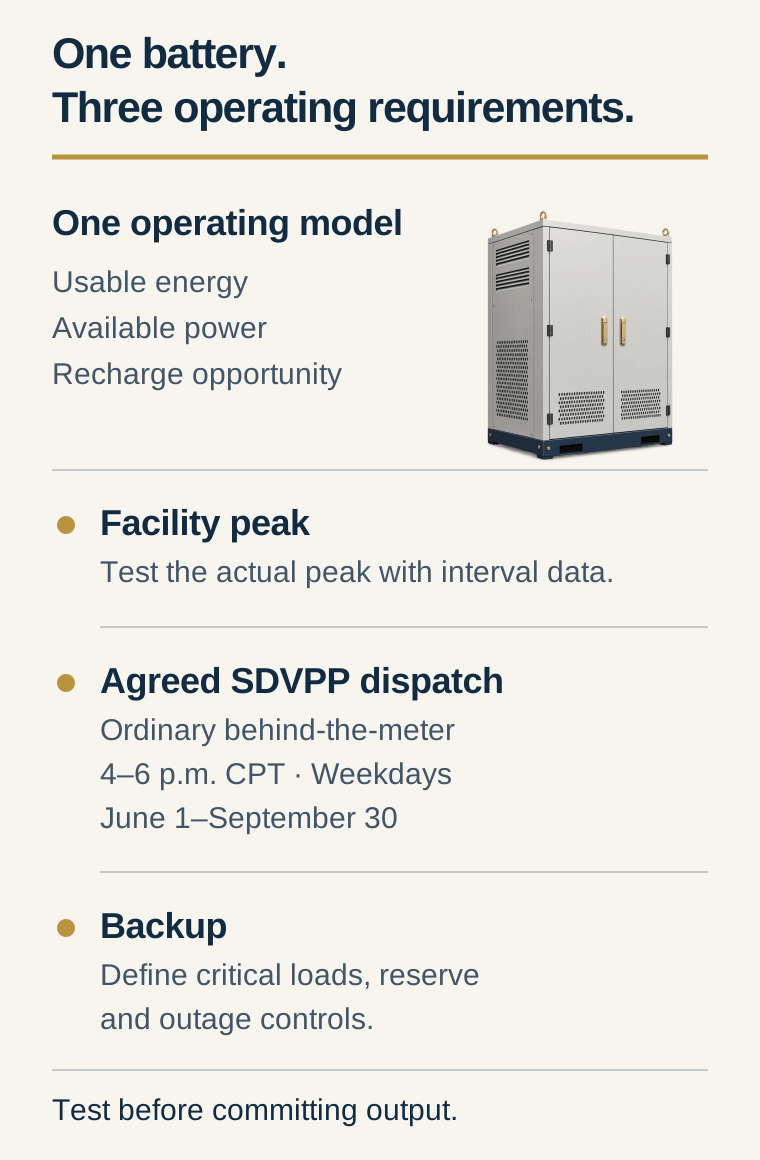
For a simple sizing illustration, delivering 100 kW for two hours requires 200 kWh of delivered energy. That calculation excludes charging and conversion losses, degradation, operating limits and any backup reserve. It is an energy requirement, not a recommendation for a 200 kWh battery. The proposed equipment must support the actual duty at the relevant point of measurement.
Have the controls provider explain the sequence in plain language. When does charging finish? What state of charge is required at 4 p.m.? What happens if the morning load consumes more energy than forecast? Who receives an alert when the next commitment is at risk? These answers are more useful than a list of software features.
How much does ComEd pay for scheduled dispatch?
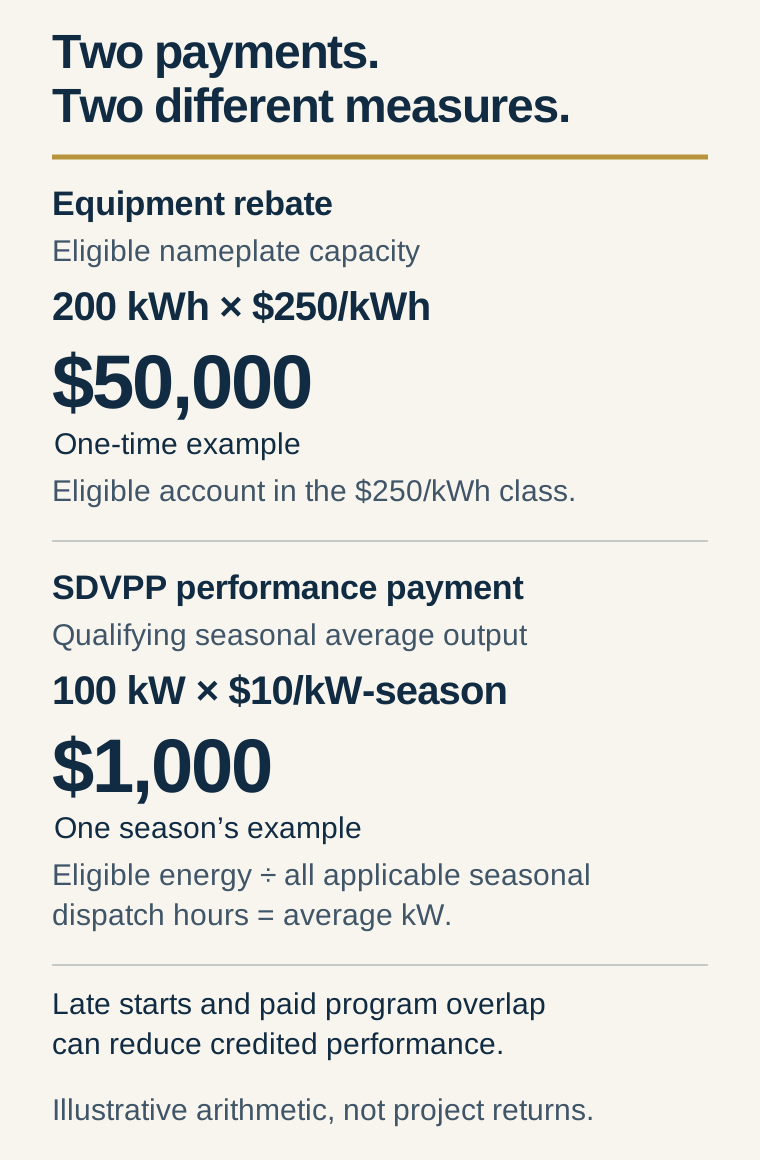
ComEd’s SDVPP performance payment is $10 per kW-season of qualifying average output, calculated after the season. It is separate from the equipment rebate. A 100 kW battery rating does not establish a 100 kW seasonal result. Payment depends on the measured injections and the full set of applicable dispatch hours.
Sheet 475 divides eligible energy delivered during the dispatch windows by all applicable window hours in the season. That produces the average kW used for payment. Late enrollment does not shorten the denominator: window hours before service began count as zero. Confirm the start date before using a full-season payment in a forecast.
Check other paid programs before adding the credits together. Sheet 475 allows ComEd to reduce credited performance when another program compensates grid services during the same dispatch-window hours. Give the proposer your current and planned demand-response or grid-service commitments. Do not forecast two full payments for the same hours without confirming how ComEd will treat the overlap.
Illustrative seasonal payment, before project costs or taxes
| Calculated seasonal average | Tariff rate | Illustrative payment |
|---|---|---|
| 50 kW | $10 per kW-season | $500 |
| 100 kW | $10 per kW-season | $1,000 |
These examples apply the tariff’s arithmetic. They are not measured GEC project results or forecasts for a particular battery. They exclude equipment cost, energy purchased for charging, losses, maintenance and financing. Use the payment as one input in the project model, alongside the operating duty required to earn it.
Keep the rebate and dispatch payment separate in the comparison. For a qualifying larger commercial account in the $250/kWh class under ComEd’s 2026 rebate terms, 200 kWh of eligible nameplate capacity would produce a $50,000 equipment rebate before project-specific limits. A qualifying seasonal average of 100 kW would produce a separate $1,000 dispatch payment. These figures illustrate different payment units. They do not establish the equipment size, reserve, eligibility or net return for a project.
Also confirm where output is measured. The tariff distinguishes storage-inverter measurements for standalone and AC-coupled batteries from combined export at the shared inverter for DC-coupled equipment. A proposal should identify the relevant meter or inverter data, rather than treating every battery rating as interchangeable with bill reduction or program performance.
Will dispatch reduce demand charges and capacity costs?
Scheduled dispatch and bill savings sometimes occur together, but they use different measurements. Monthly demand charges depend on the account’s billing rules. Capacity exposure depends on system-peak allocation and the supply contract. Evaluate the same battery schedule against each rule, then calculate the bill change without counting the same benefit twice.
A facility’s highest monthly load might occur before the dispatch window. Reducing load from 4 to 6 p.m. would then leave that earlier peak untouched. The battery might also discharge earlier, but the model must show enough remaining energy and recharge opportunity to meet its later commitment. Use interval data rather than a monthly bill total to test this.
Capacity has another calendar. PJM’s capacity-obligation methodology uses summer peak information for a later delivery year. A battery project should identify the applicable ComEd allocation method and how the supplier passes a lower obligation through to the customer. Under that methodology, summer 2027 observations feed the June 2028 through May 2029 delivery year. A lower calculated capacity tag does not, by itself, establish an immediate reduction under every supply contract.
For rebate eligibility and documentation, start with GEC’s ComEd commercial battery rebate guide. For the bill calculations, use the ComEd demand-charge and battery-payback guide. This article focuses on the dispatch agreement and the operating choices it creates. A facility payback period still needs the account’s tariff, load data and project costs.
Can the battery still provide backup power?
A battery needs a defined reserve and suitable electrical controls to support loads during an outage. Energy committed to routine dispatch is not automatically available for backup. Specify the critical loads, required runtime and minimum reserve first, then test whether the proposed dispatch schedule preserves that reserve under realistic operating conditions.
The EPA Power Resilience Guide discusses storage and microgrids as parts of a facility’s resilience plan. Buying storage is only one part of that plan. An outage-capable design also needs the controls and electrical arrangement to isolate from the grid and serve the intended loads. Ask which circuits remain energized and how the transition works.
For a representative illustration, a steady 50 kW critical load needs 100 kWh of delivered energy for two hours. Actual sizing must account for starting loads, losses, battery limits and changing demand. A list of critical equipment is the starting point. A promised number of backup hours without the supported load is incomplete.
Keep the control rules explicit. The SDVPP tariff gives its commitment priority over conflicting commitments and provides a utility-directed bypass provision. That provision does not establish a blanket customer right to disregard dispatch whenever reserve is preferred. Resolve the reserve setting and outage procedures in the participant agreement and system design before committing output.
What is changing for standalone battery rebates?
ComEd has published a future-dated advance copy of its rebate tariff addressing standalone storage. The advance copy checked October 9, 2026 states that standalone-storage rebate applications will not be accepted until January 1, 2027. Treat that date as a provision in the published advance copy, subject to confirmation in the final effective tariff.
The advance rebate tariff, sheet 248.4 is labeled for information only. It was filed September 4 and carries an October 19, 2026 effective date. This guide does not treat that future-dated copy as proof that applications are open or that the filing has received final approval. ComEd’s proposed-filings page currently lists October 19 for this revision.
The advance copy defines standalone storage as a battery interconnected after June 1, 2026, without renewable-generation pairing, that charges only from the grid. Its rebate limits generally include 25,000 kWh of nameplate energy and 5 kWh per participating kW, with a specified exception for certain earlier interconnection applications. Review the effective eligibility, sizing limits and agreement terms for the actual project.
For a storage-only project, separate the decisions. Confirm the applicable eligibility and application rules with ComEd. Establish the interconnection and construction schedule. Then model the project with the rebate timing and amount available to that account. A planned program change should not appear as cash already secured.
What should you ask for before accepting a proposal?
Ask for one operating model linking the battery’s physical limits to the dispatch agreement, utility bill and backup requirement. It should state the data used, the committed output and who controls the equipment. The resulting investment case should remain understandable when facilities, finance and the controls provider review it together.
- 1 Confirm the account and program category. Identify the meter, delivery class, supply contract, rebate application history and enrollment path. Separate an optional participant from a rebate-linked participant. Record which documents support the classification. Confirm the effective rate-product rules, especially around the proposed October 19 revision.
- 2 Show the load and battery on the same timeline. Use representative high-load days and a full-year simulation where data permit. Include charging, discharge, usable energy, losses, degradation assumptions and the required state of charge before dispatch.
- 3 Put the proposed commitment in writing. State the kW commitment, its measurement point, the season and the term. Show how the equipment supports it. Document smart-inverter compatibility, data permissions, control responsibility and conflicting program commitments. The tariff requires previously committed injections to be released from the earlier commitment before being committed under SDVPP. Rebate inverter-setting requirements also constrain later control changes. Ask which changes require ComEd’s agreement or written consent.
- 4 Separate the financial outputs. Show the equipment rebate, SDVPP performance payment, demand-charge change and capacity-related bill change individually. Include charging costs and ongoing fees. Apply sheet 475’s same-hour double-counting provision before combining any other paid grid-service revenue with SDVPP credits.
- 5 Test a difficult day and an outage. Show what happens after an earlier discharge, a charging interruption or an equipment limitation. For backup, name the loads, runtime and reserve. Document the applicable bypass and outage procedures rather than assuming an unrestricted override.
- 6 Assign an operating owner. Identify who watches performance, responds to alerts and reconciles the seasonal payment. Include a handoff plan for a change in facility staff, controls vendor or project ownership.
The next step is a load-and-controls review. Bring the most recent electric bill, available interval data and the loads you need to keep running. GEC’s battery storage engineering service provides the engineering context for evaluating those requirements alongside the proposed equipment and utility obligations.
Common questions about ComEd battery dispatch
No. ComEd’s SDVPP tariff says the participant identifies the committed injections and sets no minimum commitment. The agreed amount belongs in the participant agreement. Size that commitment around usable energy, equipment limits, recharge and reserve, then verify how the agreement measures performance throughout the required window.
The $10 per kW-season payment uses qualifying average output across the seasonal dispatch hours. It is not a payment for each installed kWh of storage. The tariff converts measured eligible energy into average kW before applying the rate, so nameplate capacity alone does not determine the payment.
No. The tariff distinguishes the rebate-linked cohort from optional participants. Its required cohort concerns eligible storage whose rebate was submitted and subsequently received on or after June 1, 2026. Confirm the project’s application and award history. Installation date alone does not establish whether that requirement applies.
Backup remains a design and operating question. Specify the critical loads, electrical isolation, reserve and runtime, then evaluate dispatch against those requirements. The tariff prioritizes its commitment over conflicting commitments. Its utility-directed bypass provision should not be read as an unrestricted customer override for preserving charge.
Lower eligible output can reduce the seasonal average used to calculate payment. Hours before a mid-season enrollment count as zero, and same-hour payments from another grid-service program can reduce credited performance. Review the participant agreement for operating duties and remedies. A smaller payment is not proof that a missed commitment has no other consequences.
You do not need to wait to examine the bill, collect interval data or define critical loads. Those inputs establish whether storage merits a project-specific study. Confirm program availability, final tariff terms and construction timing before committing capital. This guide does not establish eligibility or savings for an individual account.
Know what your battery will do at 4 p.m.
Discuss your electric bill, available load data and backup priorities with GEC’s engineering team. Start by identifying the questions your battery proposal needs to answer before you commit. No commitment to move forward.
General information, not tax, legal or project-specific engineering advice. Program eligibility, compensation and operating duties depend on the applicable tariffs, equipment and signed agreements. Examples are illustrative and exclude project costs and taxes. How this guide was made: prepared for Drew Mays’s GEC byline with AI-assisted research and drafting, using public tariff sources rechecked October 9, 2026. Header image: an illustration of commercial battery cabinets and a solar-equipped industrial building, not a documented GEC installation.
Continue reading GEC’s Illinois Energy Market guides.